What Is Agentic AI?
Agentic AI refers to AI systems that can understand a goal, determine the steps required to achieve it, use available tools or applications, and take actions with limited manual intervention.
Traditional generative AI primarily responds to a request.
For example:
Traditional AI:
“Here are several hotels you could book.”
Agentic AI:
“Based on your preferences, I found suitable options, compared prices, selected your preferred room type, and prepared the booking for your approval.”
This difference between answering and acting is what makes agentic AI particularly important for mobile applications.
How Is Agentic AI Changing Mobile Apps?
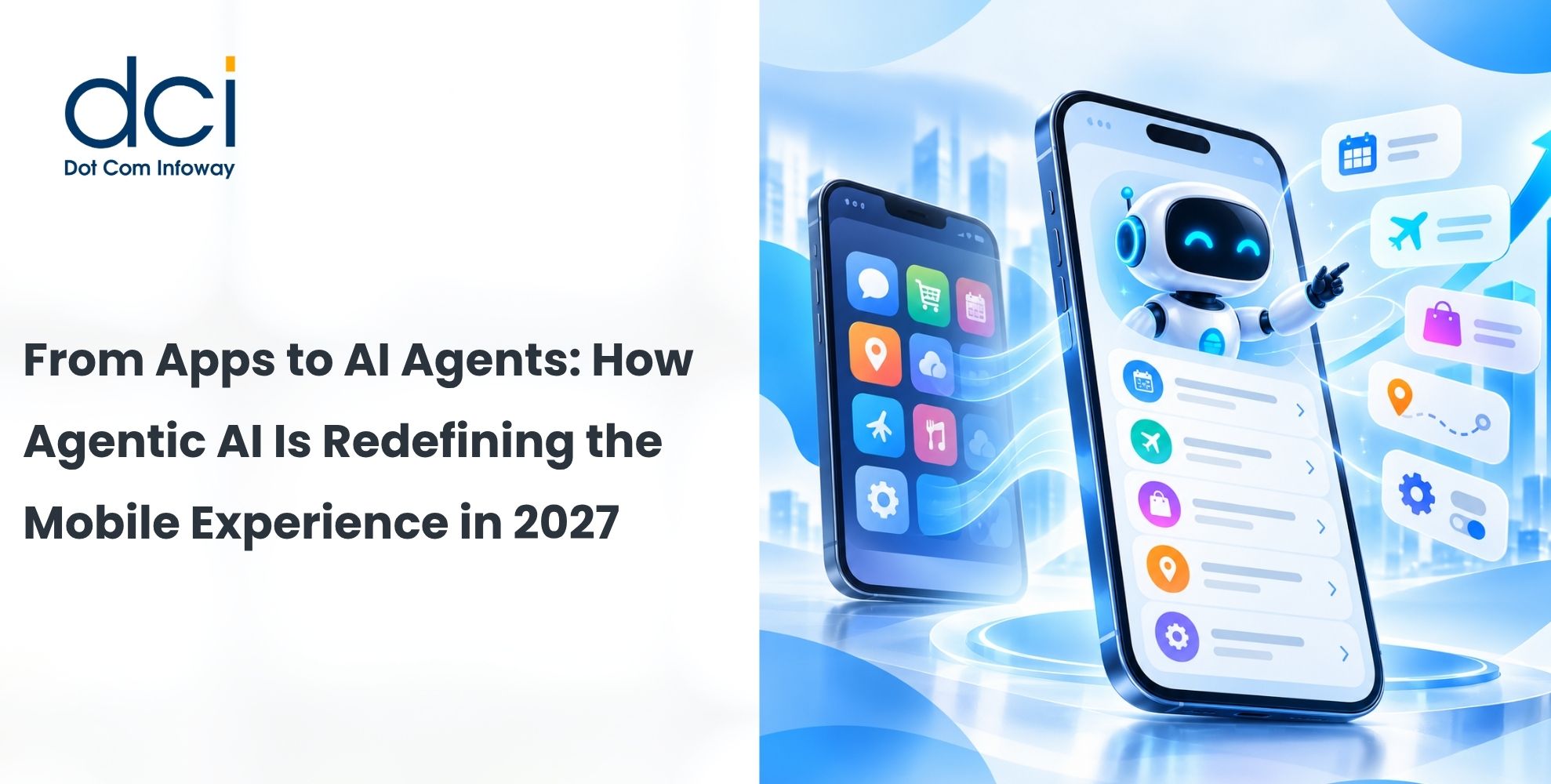
Agentic AI could shift mobile experiences from app-driven interactions to intent-driven interactions.
Today, booking a restaurant may involve:
Opening an app → searching nearby restaurants → applying filters → checking availability → selecting a time → confirming the reservation.
With an AI agent, a user could simply say:
“Find a highly rated Italian restaurant near my office and book a table for four at 7:30 PM.”
The AI system could understand the request, access relevant services, evaluate available options and complete or prepare the required action.
The user provides the intent.
The AI coordinates the workflow.
That could significantly reduce the number of taps, screens and manual decisions required to complete common mobile tasks.
1. Apps May Become Services for AI Agents
One of the biggest changes may happen behind the interface.Mobile applications have traditionally been designed primarily for human interaction. Users navigate screens, buttons, menus and forms.
Agentic mobile ecosystems introduce another type of user: The AI agent.
Apps may increasingly need to expose specific functionality so authorized AI systems can interact with them.
Google’s experimental Android AppFunctions capability, for example, is designed to allow apps to expose functionality that AI assistants and agents can use.
For developers, this means mobile architecture may increasingly need to support both:
- Human-to-app interactions
- Agent-to-app interactions
The most successful applications may therefore become not only easy for people to use but also easy for AI systems to interact with securely.
2. Mobile Experiences Will Become More Intent-Driven
Traditional apps make users understand the application’s structure.
Users need to know:
Where a feature exists.
Which screen to open.
Which filters to apply.
Which fields to complete.
Agentic AI reverses this relationship.Instead of users adapting to an app, the software begins adapting to what the user wants to accomplish.
A user might simply request:
“Reorder the groceries I bought last week.”
“Reschedule my appointment to Friday afternoon.”
“Find the cheapest available flight that matches my usual preferences.”
“Summarize my expenses this month.”
The AI agent determines which application, service or workflow is necessary.This transition could make intent one of the most important elements of future mobile UX.
How AI Agents Could Connect Apps and Personal Context
3. AI Agents Can Work Across Multiple Apps
Agentic AI can potentially coordinate workflows involving several services.Consider planning a business trip.
An AI agent could potentially:
- Check the user’s calendar.
- Find available flights.
- Compare hotel options.
- Book transportation.
- Add the itinerary to the calendar.
- Share travel details with colleagues.
- Send reminders before departure.
Instead of completing seven separate workflows, the user provides one objective.This creates an important opportunity for businesses.The next generation of mobile products may need to become part of a broader AI ecosystem, rather than functioning as isolated applications.
4. On-Device AI Will Become More Important
Agentic systems often require access to personal context.One significant direction in mobile technology is therefore on-device AI.
Qualcomm’s latest mobile AI architecture, for example, has been designed to run more complex agentic AI workloads directly on mobile devices, reducing dependence on constant cloud processing.
Processing certain AI workloads locally can potentially provide:
- Faster responses
- Reduced latency
- Better offline functionality
- Greater privacy for sensitive information
- Lower dependence on cloud infrastructure
Future mobile applications may use a hybrid approach in which lightweight or privacy-sensitive AI processing happens on-device while more computationally intensive operations continue in the cloud.
5. Personalization Will Move Beyond Recommendations
Mobile apps already personalize feeds, products and notifications.Agentic AI can take personalization much further.
Instead of simply recommending what a user might want, an AI agent could understand:
- Previous actions
- Preferences
- Location context
- Calendar activity
- Frequently used services
- Communication patterns
- Current objectives
It could then use that context to determine what action is most useful.For example, a travel application might recognize an upcoming trip and proactively surface relevant transportation options.An eCommerce app could help reorder frequently purchased products with minimal interaction.
The goal shifts from:
“What content should we show the user?”
to:
“What is the user trying to accomplish?”
How Agentic AI Could Reshape Mobile UX and User Control
6. Mobile UI Could Become Simpler
Agentic AI does not mean graphical interfaces will disappear.But their role could change.Instead of navigating through multiple screens to complete simple tasks, users could increasingly interact through:
- Natural language
- Voice commands
- Conversational interfaces
- Context-aware suggestions
- AI-generated action cards
Traditional UI will still be important for browsing, visual comparison, confirmation and complex decisions.
However, repetitive navigation could increasingly be handled by AI.
This creates an opportunity for mobile designers to build interfaces around outcomes instead of workflows.
7. Trust and User Control Will Be Critical
Giving AI permission to perform actions introduces significant responsibility.Users need confidence that the system understands what they want and will not take unintended actions.
Future agentic AI mobile apps will therefore need strong safeguards around:
- User permissions
- Authentication
- Data privacy
- Action confirmation
- Transparency
- AI decision visibility
- Permission revocation
High-impact actions such as purchasing products, transferring money or sharing private information may still require explicit confirmation.Successful agentic experiences will not simply be autonomous.They will need to be controllable and transparent.
What Does Agentic AI Mean for Businesses?
The transition toward AI agents does not necessarily mean apps will disappear.Instead, their role may evolve.Businesses should begin thinking beyond:
“How do we get users to open our app?”
A more relevant question could become:
“How easily can an authorized AI agent use our service when a customer requests it?”
This may require businesses to invest in:
- API-first application architecture
- AI-ready mobile development
- Secure authentication systems
- Structured application functionality
- Agent-compatible workflows
- Context-aware personalization
- Strong permission management
Companies that begin preparing their digital products for this transition may be better positioned as mobile ecosystems become increasingly agent-driven.






![The Game Marketing Guide: Pre and Post-Launch Strategies [Infographic]](https://www.dotcominfoway.com/wp-content/uploads/2023/09/DCI-Game-Marketing-blog-1.jpg)