The Challenge With Traditional App Development
Traditional mobile app development usually requires separate development processes for Android and iOS platforms.
A typical workflow involves:
- Creating UI/UX designs
- Writing platform-specific code
- Developing backend integrations
- Testing across multiple devices
- Fixing compatibility issues
- Preparing separate app store releases
While this approach provides complete customization, it often increases:
- Development time
- Project costs
- Maintenance efforts
- Resource requirements
For startups and businesses trying to validate ideas quickly, long development cycles can delay market entry and reduce opportunities.
This is where multiplatform frameworks and AI-assisted development tools provide a major advantage.
What Is FlutterFlow and Why Is It Transforming App Development?
FlutterFlow is a low-code development platform built on Google’s Flutter framework that enables businesses to create applications faster using visual development tools, reusable components, and automated workflows.
Unlike traditional coding approaches, FlutterFlow allows developers and product teams to:
- Build user interfaces visually
- Generate production-ready Flutter code
- Connect databases and APIs
- Create responsive app designs
- Test application flows quickly
It combines the flexibility of Flutter with the speed of low-code development.
For businesses looking for faster mobile app development solutions, FlutterFlow provides a balance between rapid development and technical scalability.
How AI Is Accelerating the Software Development Process
Artificial intelligence is becoming an important part of modern application development.
AI-powered tools assist developers by automating repetitive tasks, generating code suggestions, improving testing processes, and helping teams build applications more efficiently.
Some key areas where AI improves app development include:
1. Faster Prototyping and MVP Development
Creating a Minimum Viable Product (MVP) traditionally requires weeks or months of development.
With AI-assisted tools and FlutterFlow, teams can quickly transform ideas into functional prototypes.
Businesses can:
- Test concepts faster
- Collect user feedback earlier
- Make improvements before large investments
This allows companies to validate ideas without spending excessive time on initial development.
2. Faster UI/UX Development
Design-to-development conversion is often one of the biggest time-consuming steps.
Multiplatform frameworks simplify this process through:
- Reusable UI components
- Drag-and-drop builders
- Pre-built templates
- Responsive design systems
Designers and developers can collaborate more effectively, reducing delays between design approval and implementation.
3. Single Codebase for Multiple Platforms
One of the biggest advantages of multiplatform frameworks is the ability to create applications using a shared codebase.
Instead of building separate apps for:
developers can create one application that works across multiple platforms.
This reduces:
- Development effort
- Testing requirements
- Maintenance workload
Frameworks such as Flutter enable businesses to deliver consistent experiences across different devices.
How FlutterFlow and Multiplatform Frameworks Reduce Development Timelines
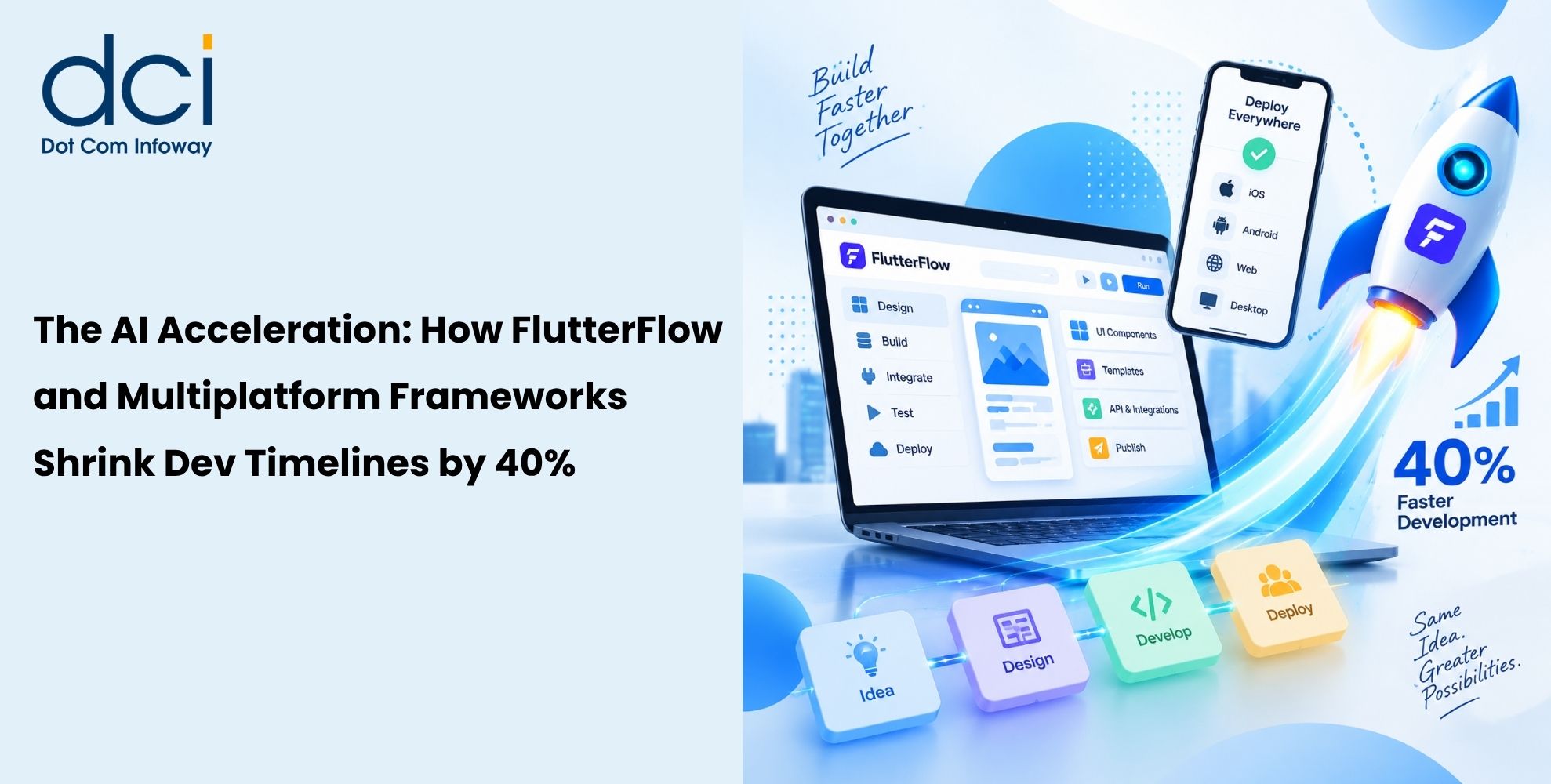
The combination of FlutterFlow, AI tools, and cross-platform development creates a faster development ecosystem.
Here are some major time-saving advantages:
Faster Development Cycles
Reusable components and automated workflows reduce the amount of manual coding required.
Teams can move from:
Idea → Prototype → Testing → Launch
much faster than traditional development methods.
Reduced Development Complexity
Managing multiple platforms separately requires additional resources.
Multiplatform frameworks simplify development by allowing teams to maintain a unified application structure.
Improved Collaboration
Modern development platforms allow:
- Designers
- Developers
- Product managers
- Business teams
to work together more efficiently.
This reduces communication gaps and speeds up decision-making.
Faster Testing and Updates
With a shared codebase, updates can be implemented more efficiently.
Businesses can:
- Release new features faster
- Fix issues quickly
- Maintain consistent performance
This improves long-term product scalability.









![The Game Marketing Guide: Pre and Post-Launch Strategies [Infographic]](https://www.dotcominfoway.com/wp-content/uploads/2023/09/DCI-Game-Marketing-blog-1.jpg)