AI-Powered Campaign Recommendations Increase Conversions by Up to 30%-Should They Be Enabled for Every Google and Meta Ads Campaign?

By

7 mins read

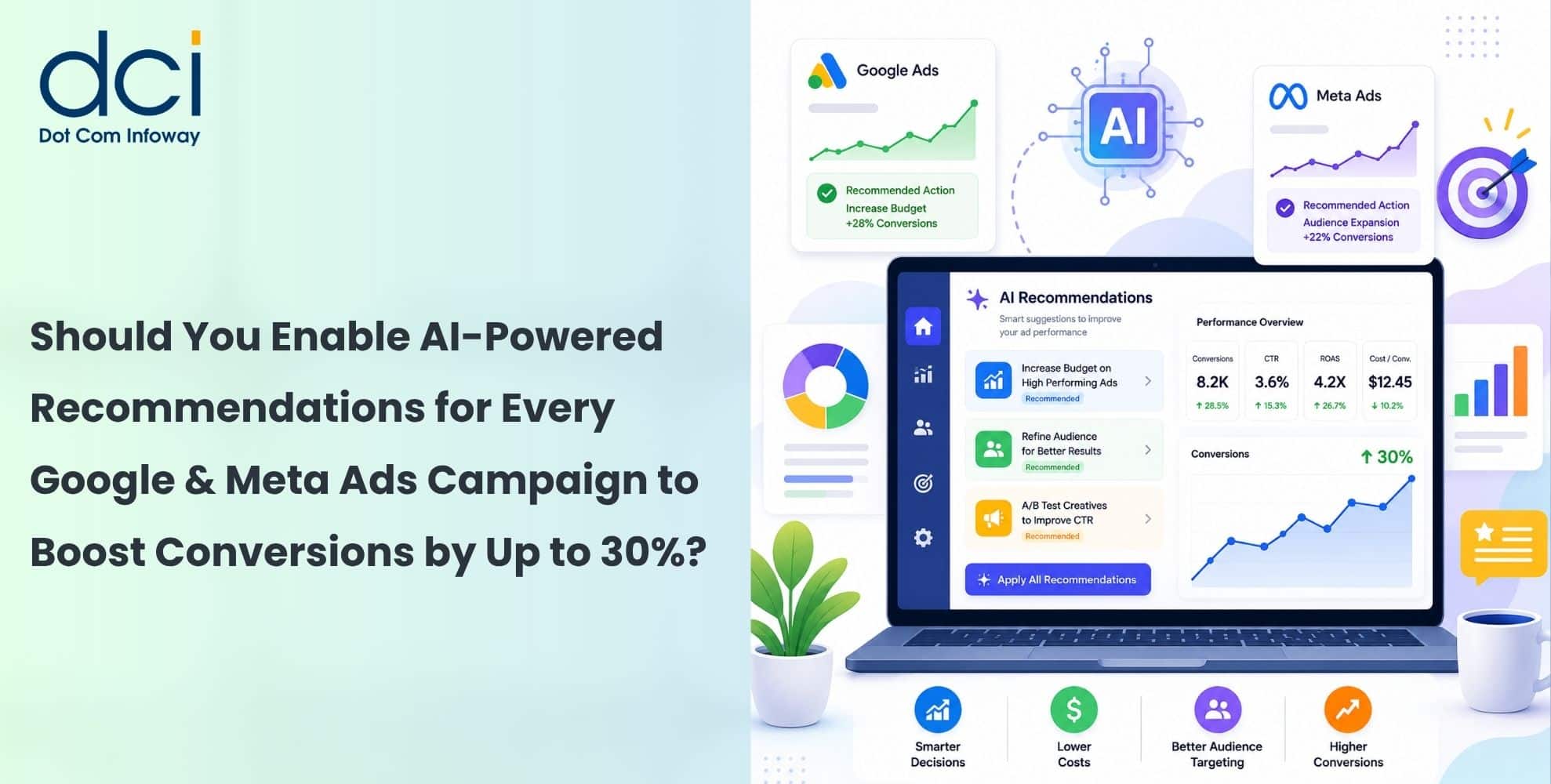
AI-Powered Campaign Recommendations help advertisers improve bidding, targeting, budgets, creatives and campaign structures using real-time performance data. Under suitable conditions, these optimizations may increase conversions by up to 30%. Businesses can also use professional performance marketing services to evaluate these automated suggestions, improve tracking and ensure that campaign decisions are aligned with revenue rather than platform-generated scores.

However, enabling every Google Ads and Meta Ads recommendation can increase spending without necessarily improving lead quality or profitability. The right approach is not complete automation or complete manual control. Advertisers need a structured system for deciding which recommendations to apply, test, modify or reject.

AI-Powered Campaign Recommendations Increase Conversions by Up to 30%—Should They Be Enabled for Every Google and Meta Ads Campaign?

Why Advertising Campaigns Underperform

    Google Ads and Meta Ads campaigns commonly underperform because of rising competition, inaccurate conversion tracking, limited audience data, weak creative testing and delayed optimization.

    Marketing teams may spend several hours reviewing reports while advertising platforms process thousands of signals in real time. These signals include device type, location, browsing behaviour, audience engagement, search intent, conversion probability and auction competition.

    The central challenge is therefore not accessing recommendations. It is identifying which recommendations support meaningful business outcomes.

    Businesses facing high ad spend but limited enquiries should first identify why ads fail before enabling additional automation.

    How Google and Meta Use AI

    Google Ads primarily uses AI to optimize campaigns around search intent, conversion probability and conversion value. Automated bidding strategies adjust bids for each auction based on the likelihood that a user will complete the selected action.

    Meta Ads relies more heavily on behavioural discovery. Its automated systems identify audiences, placements, formats and creative combinations that are more likely to generate conversions.

    Typical recommendations include:

    • Changing the bidding strategy or campaign budget
    • Expanding keywords, audiences or placements
    • Adding creative assets and testing variations
    • Improving conversion tracking
    • Consolidating campaigns or ad sets

    These changes can reduce manual work, but they should be assessed using revenue, qualified leads, return on ad spend and customer acquisition cost-not only clicks or impressions.

      When AI-Powered Campaign Recommendations Work Best

      AI-Powered Campaign Recommendations are most effective when campaigns have accurate tracking, sufficient conversion volume, clearly defined objectives and stable historical data.

      Consider an e-commerce campaign generating hundreds of purchases each month. Google or Meta can analyse customer behaviour and redistribute spending toward audiences, products, placements and time periods that produce stronger conversion rates.

      A SaaS company generating qualified demo requests can also use automated bidding to identify users with a higher probability of becoming leads. However, the platform must receive accurate conversion signals. If every form submission is counted equally, the algorithm may prioritize low-quality enquiries instead of sales-ready prospects.

      Automation is only as reliable as the data and objectives supplied to it. Advertisers can explore practical marketing automation methods to reduce repetitive work without removing human oversight.

      When Recommendations Can Waste Budget

      Applying every recommendation automatically can create several risks:

      • Broader targeting may generate irrelevant traffic.
      • Budget increases may improve volume without improving profitability.
      • New keywords may attract low-intent searches.
      • Audience expansion may reduce lead quality.
      • Automated creatives may weaken brand consistency.

      For example, a B2B software company may target senior decision-makers in selected industries. A recommendation to broaden the audience could increase form submissions, but many of those leads may come from students, job seekers or small businesses that do not match the ideal customer profile.

      Similarly, Meta’s audience expansion may improve reach and reduce cost per result while failing to generate customers with meaningful lifetime value. Businesses should understand how AI audience signals influence Meta campaign delivery before enabling broader targeting.


            mobile-design-300x300

            Should AI-powered campaign recommendations be enabled for every Google and Meta Ads campaign?
            Not always. The best results come from enabling AI recommendations that align with your campaign goals while regularly reviewing performance and making strategic adjustments.


            A Better Recommendation Review Framework

            Before applying a Google or Meta recommendation, evaluate five factors:

            1. Business relevance: Does the change support sales, qualified leads or another meaningful outcome?
            2. Data quality: Are conversions tracked accurately and connected to actual business value?
            3. Financial impact: Could the recommendation increase spending, CPA or low-quality traffic?
            4. Testing opportunity: Can the change be tested on a limited budget before wider implementation?
            5. Brand control: Could automation affect messaging, targeting or customer experience?

            For additional guidance, DCI’s article on campaign optimization explains practical ways to improve conversion performance.

                The Recommended Hybrid Approach

                The strongest strategy combines machine-learning speed with human judgement.

                AI should handle data-intensive activities such as auction-time bidding, placement analysis, pattern identification and budget allocation. Marketing specialists should control campaign objectives, customer definitions, brand positioning, creative direction and profitability requirements.

                A practical workflow is to review AI-Powered Campaign Recommendations weekly, test high-impact changes individually and compare the results against established benchmarks.

                Performance should be measured using:

                • Qualified conversion rate
                • Customer acquisition cost
                • Revenue and return on ad spend
                • Sales-qualified lead volume
                • Customer lifetime value

                This approach allows advertisers to benefit from automation without surrendering strategic control.

                Industry adoption continues to accelerate:

                • 71% of marketers say generative AI helps them spend less time on repetitive campaign tasks. (Salesforce State of Marketing)
                • 68% of marketing leaders plan to increase AI investments over the next year. (PwC AI Survey)
                • Gartner predicts that AI will influence the majority of digital advertising optimization decisions over the coming years as platforms become increasingly automated.

                Expected Outcomes

                When recommendations are implemented selectively, businesses may achieve faster optimization, lower manual management effort, better budget allocation and improved campaign scalability.

                However, the conversion increase will vary according to the industry, advertising budget, conversion volume, tracking accuracy and campaign maturity. Therefore, the “up to 30%” figure should be treated as a potential outcome rather than a guaranteed result.

                Marketers can also review current paid media trends to understand how automation, measurement and creative strategies are changing.

                  Conclusion

                  AI-Powered Campaign Recommendations should not be enabled automatically for every Google and Meta Ads campaign. They deliver the greatest value when tracking is accurate, objectives are clear and sufficient performance data is available.

                  The best-performing advertisers use AI as a decision-support system rather than allowing it to make every strategic decision. Dot Com Infoway helps businesses combine AI-Powered Campaign Recommendations, conversion tracking, creative testing and expert campaign management to improve advertising performance while maintaining control over budget, brand consistency and lead quality.

                  Latest Posts

                  Get the latest insights from Dot Com Infoway straight to your inbox.