From Web 1.0 to AI Agents: Lessons from Over Two Decades in Tech

By

8 mins read

In 2000, a business website was often a digital brochure: a few HTML pages, contact details, and a basic form. Today, software can interpret intent, generate content, call APIs, coordinate tasks, and act with limited human intervention. Technology Evolution from Web 1.0 to AI Agents is therefore not simply a story of faster computing. It is how the internet moved from publishing information to enabling participation, powering transactions, and now executing increasingly complex decisions.

At Dot Com Infoway, operating since 2000 has meant building through several technology cycles. One lesson has remained constant: sustainable technology strategy comes from understanding the shift in user behaviour and business architecture behind every new tool. Being part of the digital industry since the Web 1.0 era has given DCI direct exposure to multiple generations of transformation.

From Web 1.0 to AI Agents: Lessons from Over Two Decades in Tech

Why Technology Changes Faster Than Business Models

    Every major technology wave creates a similar challenge for businesses. Organisations see a new interface or capability and often attempt to connect it to an operating model designed for an earlier generation of technology.

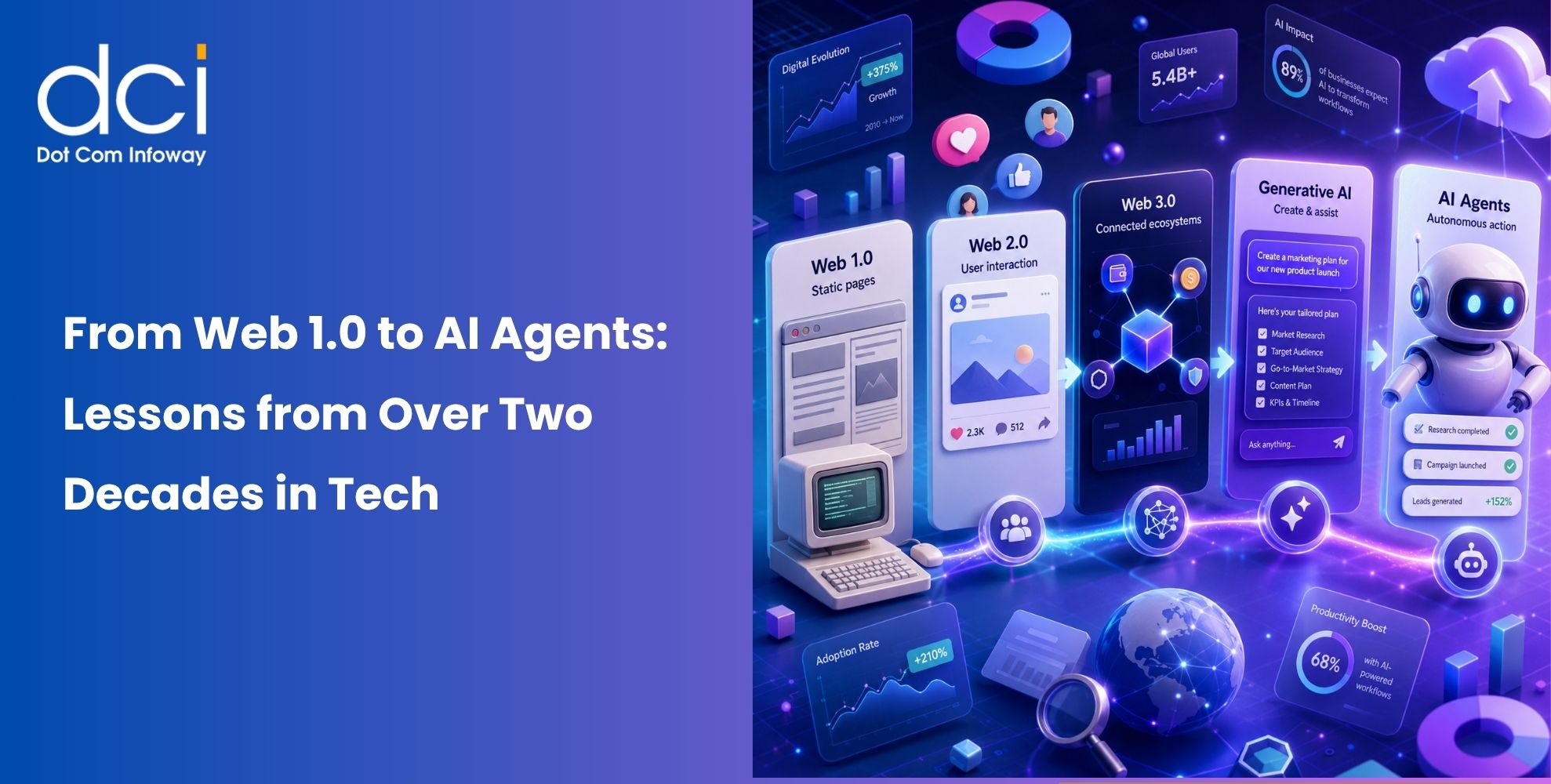
    During Web 1.0, the priority was getting information online. Web 2.0 introduced participation, communities, and user-generated content. Mobile shifted digital interactions from desktop sessions to continuous access. Cloud computing made infrastructure scalable and flexible. Generative AI changed software from simply retrieving information to creating, analysing, and interpreting it. AI agents extend this further by planning, using tools, coordinating tasks, and executing multi-step workflows.

    The progression is clear:

    • Web 1.0: Publish and read.
    • Web 2.0: Participate, share, and build communities.
    • Mobile and cloud: Access and transact anywhere.
    • Generative AI: Create, analyse, and reason through natural language.
    • AI agents: Plan, act, coordinate, and complete workflows.

    The mistake is treating each stage as an isolated technical upgrade. Adding a chatbot to a legacy process does not automatically create an AI-native organisation.

    DCI explored this transition in From Static Websites to Intelligent Systems: The AI Web Transformation, which examines how passive websites are evolving into intelligent systems capable of responding to intent, behavioural data, and context.

    What Two Decades of Technology Change Actually Teach Us

    Technology changes quickly, but strong fundamentals like performance, security, usability, and data quality remain essential.

    McKinsey reports that 88% of organisations use AI in at least one business function, while 62% are experimenting with AI agents. Stack Overflow also found that 84% of respondents use or plan to use AI tools.

    The key lesson is clear: successful AI adoption requires strong systems, human oversight, and measurable business value.

        Building for Adaptability, Not the Latest Tool

        Businesses preparing for the agentic era need systems capable of absorbing continuous technological change. That requires modular architectures, well-designed APIs, reusable data layers, observability, security controls, and clear governance mechanisms.

        DCI’s Beyond Chatbots: Practical LLM Use Cases in Modern Web Development explains how LLMs are already expanding beyond conversational interfaces into coding, content architecture, personalisation, testing, documentation, and data interpretation.

        The next stage is agentic orchestration, where software does not merely answer a prompt. It determines which approved systems, tools, APIs, and information sources are required to complete a task.

        A practical modernisation strategy should:

        • Identify high-volume workflows where decisions and handoffs create measurable delays.
        • Expose business data through governed APIs instead of keeping it locked inside isolated systems.
        • Introduce human approval for high-risk actions involving payments, permissions, customers, or compliance.
        • Measure completion rates, error rates, cycle time, operational cost, and revenue impact.
        • Maintain model and vendor flexibility so the architecture can evolve with the market.

        This foundation matters because an AI agent is only as effective as the systems it can safely access.

        DCI’s The Shift to AI-Native Apps: Agents, Generative AI & Real-Time Intelligence examines this move from reactive software toward applications designed around prediction, intelligent automation, and real-time decision-making.

        Why AI Agents Represent a Different Technology Cycle

        Traditional automation follows fixed rules, while generative AI creates responses. AI agents go further by interpreting goals, selecting tools, retrieving information, and completing multi-step tasks.

        For example, in sales, an AI agent can research prospects, update CRM records, prepare personalised outreach, and schedule follow-ups with defined approval controls.

        Gartner predicts that by 2028, 33% of enterprise software applications will include agentic AI, and 15% of daily work decisions could be made autonomously. However, Gartner also expects over 40% of agentic AI projects to be cancelled by 2027 due to cost, risk, and unclear business value.

        DCI’s AI agent productivity article explores how agents can improve workflow efficiency and business automation.


                mobile-design-300x300

                Ready to Move Beyond Traditional Digital Experiences?
                Partner with Dot Com Infoway to build intelligent, AI-powered solutions that drive business growth. Talk to Our AI Experts


                From Digital Presence to Intelligent Execution

                The most important change created by the Technology Evolution from Web 1.0 to AI Agents is not simply the addition of more AI. It is the emergence of an operating model in which software can actively participate in work instead of only supporting human actions.

                Well-designed agentic systems can create:

                • Faster execution by reducing repetitive coordination and manual handoffs.
                • More consistent customer experiences through context-aware workflows and responses.
                • Better use of institutional knowledge across support, sales, operations, and development.
                • Greater scalability when routine decisions can operate safely within governed boundaries.

                The organisations gaining the strongest advantage will not necessarily be those deploying the largest number of agents. They will be the businesses connecting agents to reliable data, clear objectives, accountable owners, secure systems, and measurable performance indicators while maintaining architectural flexibility.

                This is particularly important as AI moves deeper into core business operations. An agent that can access CRM data, customer records, financial information, analytics platforms, or internal tools needs far stronger governance than a basic website chatbot.

                      What Technology Leaders Should Prepare for Next

                      The AI-agent era is still developing, but technology leaders do not need to predict every platform or model to prepare effectively.

                      The priority should be improving the systems that intelligent applications depend on: structured data, accessible APIs, secure authentication, reliable integrations, measurable workflows, and clear ownership.

                      Businesses should also resist the temptation to automate everything simply because AI makes automation technically possible. High-value implementation begins with processes where speed, consistency, personalisation, or operational efficiency can be clearly measured.

                      The organisations that treated mobile, cloud, and analytics as long-term capabilities rather than temporary trends generally became more adaptable. The same mindset is becoming necessary for AI.

                        Final Perspective

                        Technology Evolution from Web 1.0 to AI Agents shows how every major technology shift brings digital systems closer to understanding and acting on user intent.

                        For Dot Com Infoway, more than two decades in technology have shown that long-term success depends on building adaptable, scalable, and future-ready digital platforms. Through its web development services, DCI helps businesses modernise websites and web applications with architectures ready for AI, automation, and evolving user expectations.

                        Businesses that strengthen their digital foundations today will be better prepared to adopt AI agents and future technologies with greater speed and confidence.

                        Dot Com Infoway helps brands create data-driven LinkedIn and content strategies that improve engagement, digital authority and qualified lead generation.

                        Latest Posts

                        Get the latest insights from Dot Com Infoway straight to your inbox.