



Every website needs regular checks to maintain strong search visibility, but identifying which issues to fix first can be challenging. A Website Grader simplifies this process by evaluating your website, highlighting SEO and AEO issues, and helping you prioritize improvements based on their potential impact. Instead of trying to fix everything at once, you can focus on the problems that matter most. This guide explains how to use a Website Grader to turn audit results into a clear, actionable SEO and AEO improvement plan.
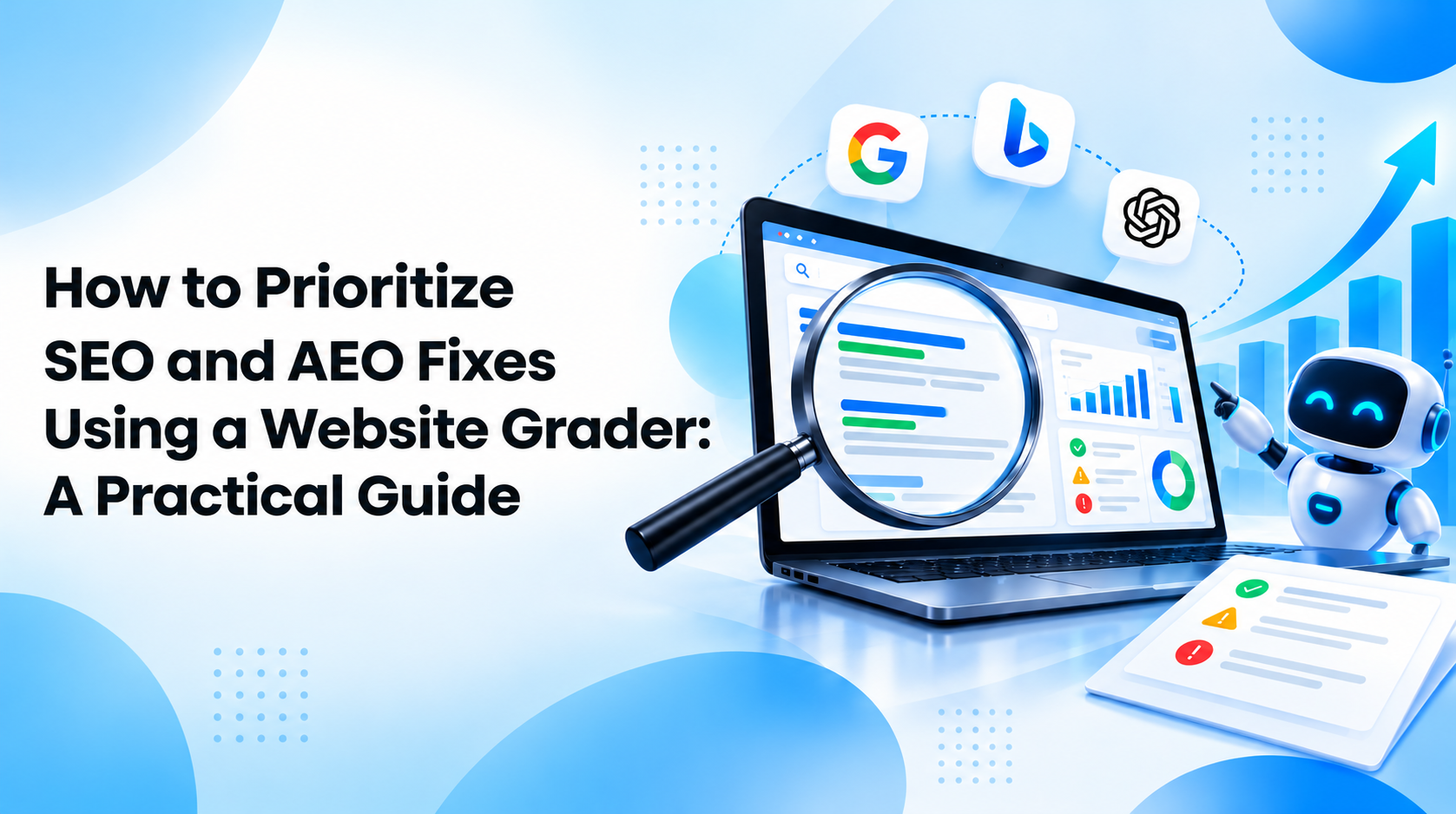
How to Prioritize SEO and AEO Fixes Using a Website Grader: A Practical Guide
7 mins read
Why a Website Grader Is the Smartest First Step in Your Website SEO Audit
Guesswork is expensive. Teams often rewrite content when the real problem is a slow server, or chase backlinks while key pages are blocked from crawling. A Website Grader replaces opinion with evidence. It runs a structured website performance analysis and produces a website grading report that you can share with developers, writers, and stakeholders. Compared with scattered SEO audit tools, a single graded report gives everyone the same starting line.
How to Read Your Website Grader Report Without Panic
Start with the overall score, but do not stop there. The category breakdown matters far more. Look for:
- Lowest-scoring categories: they usually hold the biggest gains.
- Issues affecting many pages: one template fix can solve hundreds of URLs at once.
- Crawling and indexing warnings: if search engines cannot reach a page, nothing else matters.
- Repeated patterns: duplicate titles, missing descriptions, or oversized images.
What Your Website Grader Score Actually Measures
Knowing them helps you judge which findings deserve attention:
- Technical health: crawlability, broken links, redirects, sitemaps, and schema markup. These are your technical SEO issues.
- Speed and usability: load time, Core Web Vitals, and mobile layout.
- On-page quality: titles, headings, meta descriptions, and content depth.
- Security and trust: HTTPS, safe browsing, and accessibility signals.
- Content structure: scannable formatting and clear answers that support search engine optimization and AI-generated summaries.
For a more detailed evaluation of website health and search performance, businesses can explore SEO services from Dot Com Infoway to understand how technical improvements and on-page optimization support organic visibility.
A Simple Framework for SEO Issue Prioritization
Once you have the report, sort every finding by two questions: how much will it improve organic traffic, and how much effort will it take? Use the three tiers below to sequence your SEO and AEO fixes without burning out your team.
Tier 1: Fix Immediately
These problems block visibility entirely.
- Pages accidentally set to noindex or blocked in robots.txt
- Broken key pages, 404 errors, and long redirect chains
- Very slow mobile load times
- Missing HTTPS or security warnings

Ready to improve your search visibility in 2027?
Dot Com Infoway helps businesses strengthen their SEO and AEO strategies to improve organic rankings, increase answer visibility, and stay discoverable across traditional search engines and AI-powered platforms.
Tier 2: Schedule This Month
These issues weaken performance but do not break it.
- Missing or duplicate title tags and meta descriptions
- Thin content on pages that should drive revenue
- Weak internal linking between related pages
- Missing alt text and structured data
Tier 3: Keep in the Backlog
Useful polish for later.
- Minor formatting inconsistencies
- Tweaks on low-traffic pages
- Cosmetic design adjustments with no ranking impact
Where AEO Optimization Fits Into Your Plan
Search is no longer just ten blue links. Answer Engine Optimization focuses on making your content the source that AI assistants, featured snippets, and voice tools pull from. Many graders now flag answer-readiness, so treat those findings as a second track alongside classic fixes. Practical AEO optimization usually means:
-
- Placing a direct, 40 to 60 word answer beneath question-style headings
- Adding FAQ sections and structured data markup
- Showing clear authorship, publish dates, and trustworthy sources
- Using consistent names for your brand, products, and locations
- Keeping pages fast and fully crawlable
These steps strengthen AI search visibility and overall search visibility at the same time, so the effort is never wasted. To understand the differences between traditional search optimization and answer-focused strategies, read our related guide on SEO Audit vs AEO Audit. Businesses looking to improve their visibility in AI-powered search can also explore LLM SEO services.
Common Mistakes to Avoid
Even experienced teams stumble here. Watch out for these traps:
- Chasing a perfect 100: a score is a guide, not the goal. Revenue and rankings are.
- Ignoring business impact: fix pages that drive leads and sales before everything else.
- Skipping retests: always rescan after changes to confirm the fix worked.
- Treating the audit as one-off: turn findings into a repeatable website audit checklist and review it monthly.
- Separating teams: developers, writers, and marketers should share one plan.
A Website Grader should inform your website optimization strategy, not replace human judgment.
Frequently Asked Questions
1. What is a Website Grader?
A Website Grader is an online tool that scans your site and scores it on technical health, speed, on-page quality, and security, then lists the issues holding your performance back.
2. How often should I run a Website Grader?
Run it monthly for active sites, and again after any major redesign, migration, or content update.
3. Does a high score guarantee better rankings?
No. A strong score removes obstacles, but rankings also depend on content quality, authority, and competition.
4. Which issues should I fix first?
Start with anything that stops search engines from crawling or indexing your pages, then move to speed, titles, and content gaps.
Final Thoughts
A Website Grader turns a confusing pile of warnings into an ordered to-do list. Score first, sort by impact and effort, clear the technical blockers, then layer in answer-ready content and retest every month.
That steady rhythm is how consistent SEO and AEO fixes compound into lasting organic traffic improvement. If you would rather have experts guide the process, Dot Com Infoway can help you run the audit, build the priority plan, and carry out the work from first scan to measurable results.
Must Read


Trending Blogs


Latest Posts
 October 28, 2026
How to Improve Your Brand’s Visibility in ChatGPT, Perplexity, and Gemini: A Practical Guide to LLM SEO in 2027
Search is evolving beyond traditional search engine results, with people increasingly using AI platforms like ChatGPT, Perplexity, and Gemini to find answers. LLM SEO helps businesses improve their visibility in AI-powered search by creating useful content, maintaining an accessible...
October 26, 2026
How to Prioritize SEO and AEO Fixes Using a Website Grader: A Practical Guide
Every website needs regular checks to maintain strong search visibility, but identifying which issues to fix first can be challenging. A Website Grader simplifies this process by evaluating your website, highlighting SEO and AEO issues, and helping you prioritize...
 October 22, 2026
SEO Audit vs AEO Audit: Key Differences, Overlaps, and What Your Business Needs in 2027
Search visibility is changing as people increasingly discover information through traditional search results, featured snippets, and AI-generated answers. Businesses can no longer evaluate their digital presence solely by checking keyword rankings and organic traffic. They also need to understand...
 October 20, 2026
10 Hidden SEO and AEO Issues That Can Cost Your Business Organic Traffic and Leads
SEO and AEO issues can prevent your business from reaching the right audience, reducing organic traffic, search visibility, and potential leads. While some problems are easy to identify, others remain hidden in technical settings, content structure, keyword targeting, and...
 October 16, 2026
How to Reactivate Inactive App Users Without Increasing Your Acquisition Budget
Reactivating inactive app users is an effective way to improve engagement without increasing your user acquisition budget. While advertising, influencer marketing, and App Store Optimization can help attract new users, some may stop using your app over time. Reactivating inactive...
 October 14, 2026
Getting App Downloads but No Revenue? 7 App Marketing Problems to Fix
Getting lots of downloads is a great thing, but if you aren’t generating revenue, you could be missing valuable business opportunities. Many businesses invest significant time and money in developing and marketing their apps, yet struggle to turn downloads...
 October 12, 2026
Custom Web Development vs Website Builders: Cost, Scalability, SEO, and Long-Term ROI
Imagine that a business wants to establish its online presence. It can choose a website builder to launch a website quickly using ready-made templates, or invest in custom web development to create a website tailored to its specific needs....
 October 08, 2026
Why eCommerce Customers Abandon Checkout and How to Fix It
Let’s imagine that there is a customer who shops online. He browses the online store’s catalog, finds the item that he wants to purchase, and adds it to his cart. However, he does not complete the order, resulting in...
 October 06, 2026
From App Idea to Profitable Product: A Business Guide to Validation, Development, and Monetization
Every business wants to turn its ideas into successful applications. However, many organizations invest in development and distribution without knowing whether their products will attract customers or generate revenue. As a result, they waste resources creating applications that may...
 October 05, 2026
Is Your Mobile App Outdated? 7 Signs It’s Time for an Upgrade
Your app launched to great reviews, but a few years on, downloads have flattened and complaints are creeping in. If your business needs a mobile app upgrade, it may be time to consider modernizing it. Devices, operating systems, and...
Get the latest insights from Dot Com Infoway straight to your inbox.