Why Traditional Mobile Apps Are Not Ready for the AI Revolution
For many years, mobile applications were developed around fixed workflows. Users opened an app, searched through menus, completed actions, and exited. However, the rise of AI assistants is changing these expectations.
Apple Intelligence and Gemini Advanced are introducing a new interaction model where users can communicate naturally with technology. Instead of manually searching through multiple screens, users expect apps to provide instant answers, automate repetitive activities, and deliver relevant recommendations.
Many existing applications face challenges because their architecture was not designed for AI-powered functionality.
Common limitations include:
- Limited personalization: Traditional apps provide similar experiences for every user instead of adapting based on individual preferences.
- Disconnected data insights: Apps collect large amounts of user data but often fail to convert it into actionable intelligence.
- Poor AI integration capability: Older applications may not support AI models, APIs, or intelligent automation features.
- Manual user journeys: Users still need to complete multiple steps for tasks that AI could simplify.
For example, a traditional shopping app may allow customers to search products manually. An AI-powered shopping application can understand a request like “Find a premium laptop under my budget” and instantly provide personalized recommendations with comparisons.
This shift is already visible across industries. Streaming platforms such as Netflix and Spotify use AI-based recommendation systems to analyze user behavior and deliver personalized content experiences. AI integration has become a major factor in improving engagement and retention.
How Businesses Can Make Their Apps AI-Ready
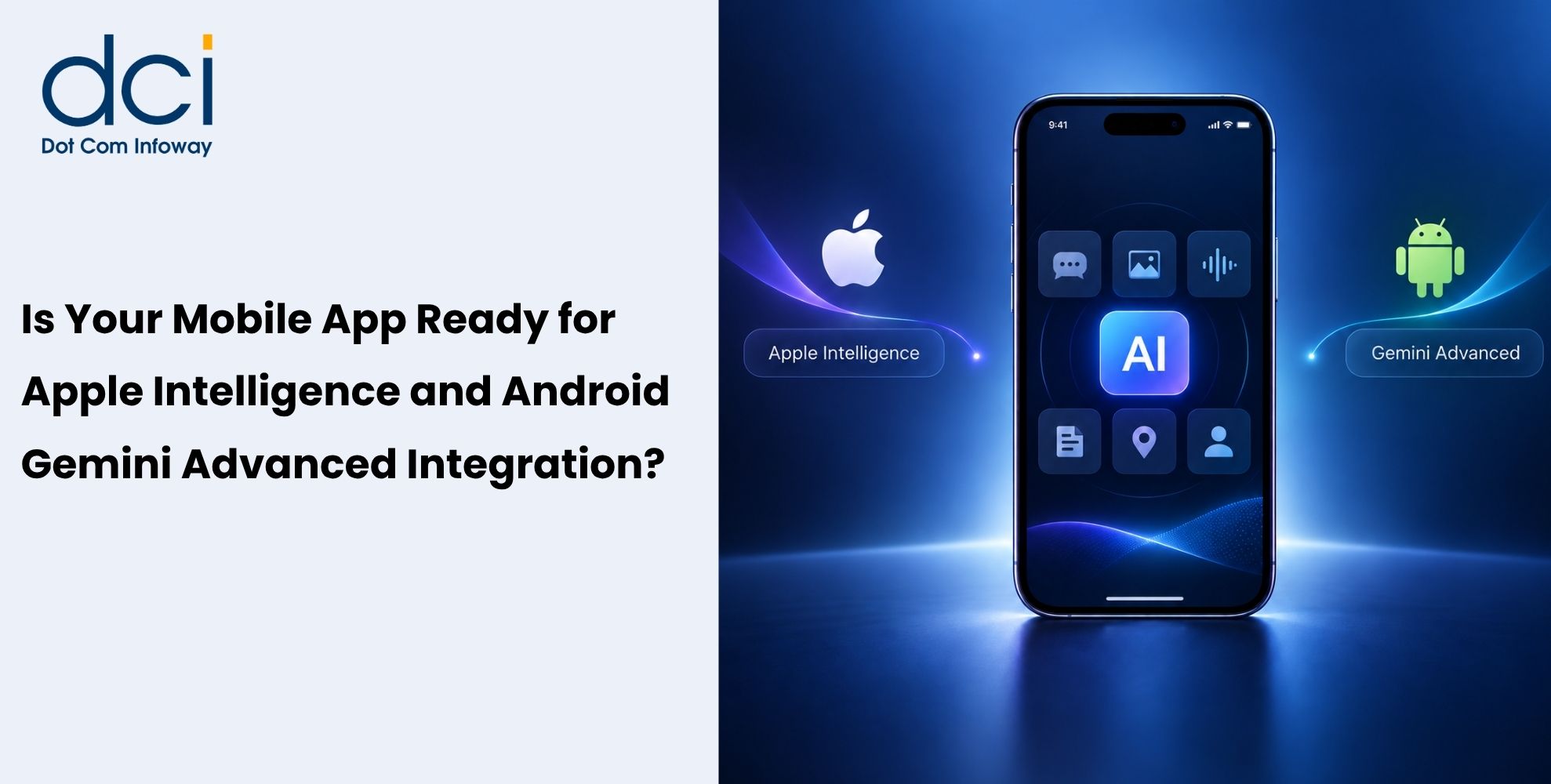
Preparing an application for Apple Intelligence and Gemini Advanced requires a strategic approach involving architecture improvements, AI models, data management, and user experience optimization.
Businesses should focus on building applications that can support intelligent features without compromising performance, security, or scalability.
1.Create an AI-Compatible Application Architecture
Modern apps need flexible architecture that can communicate with AI platforms and third-party intelligence services.
Developers should focus on:
- Cloud-based AI integrations for advanced processing
- On-device AI capabilities for faster responses
- Secure APIs for connecting AI models
- Scalable backend infrastructure for growing user demands
On-device AI is becoming increasingly important because it improves speed, privacy, and reliability. Technologies such as Apple Core ML and Google AI frameworks allow developers to process certain AI tasks directly on devices.
Businesses can also explore strategies explained in AI features into existing apps to upgrade current applications without completely rebuilding them.
2. Enable Personalized and Predictive Experiences
The biggest advantage of AI integration is the ability to understand user behavior and provide meaningful recommendations.
Future mobile applications will move beyond basic personalization. AI can analyze:
- User preferences and interaction history
- Purchase behavior
- Search patterns
- Content consumption trends
For example:
A fitness application can generate customized workout plans based on user progress.
A finance app can analyze spending patterns and provide financial suggestions.
An education platform can adjust learning difficulty based on student performance.
These intelligent experiences help businesses improve customer engagement while creating stronger user relationships.
3. Add Conversational AI and Smart Assistants
AI assistants are transforming how users interact with applications.
Instead of navigating complex interfaces, users can communicate with apps naturally through text or voice.
Examples include:
“Schedule my appointment next week.”
“Summarize my account activity.”
“Recommend restaurants near my location.”
Conversational AI improves accessibility and reduces friction, making applications easier to use for different user groups.
Apple Intelligence focuses heavily on contextual understanding, while Gemini Advanced provides advanced reasoning and multimodal capabilities combining text, images, and other inputs. Businesses need to consider these capabilities when planning future app experiences.






![The Game Marketing Guide: Pre and Post-Launch Strategies [Infographic]](https://www.dotcominfoway.com/wp-content/uploads/2023/09/DCI-Game-Marketing-blog-1.jpg)