Why Google Dropped Millions of Apps: The New App Store Quality Rules Explained

By

8 mins read

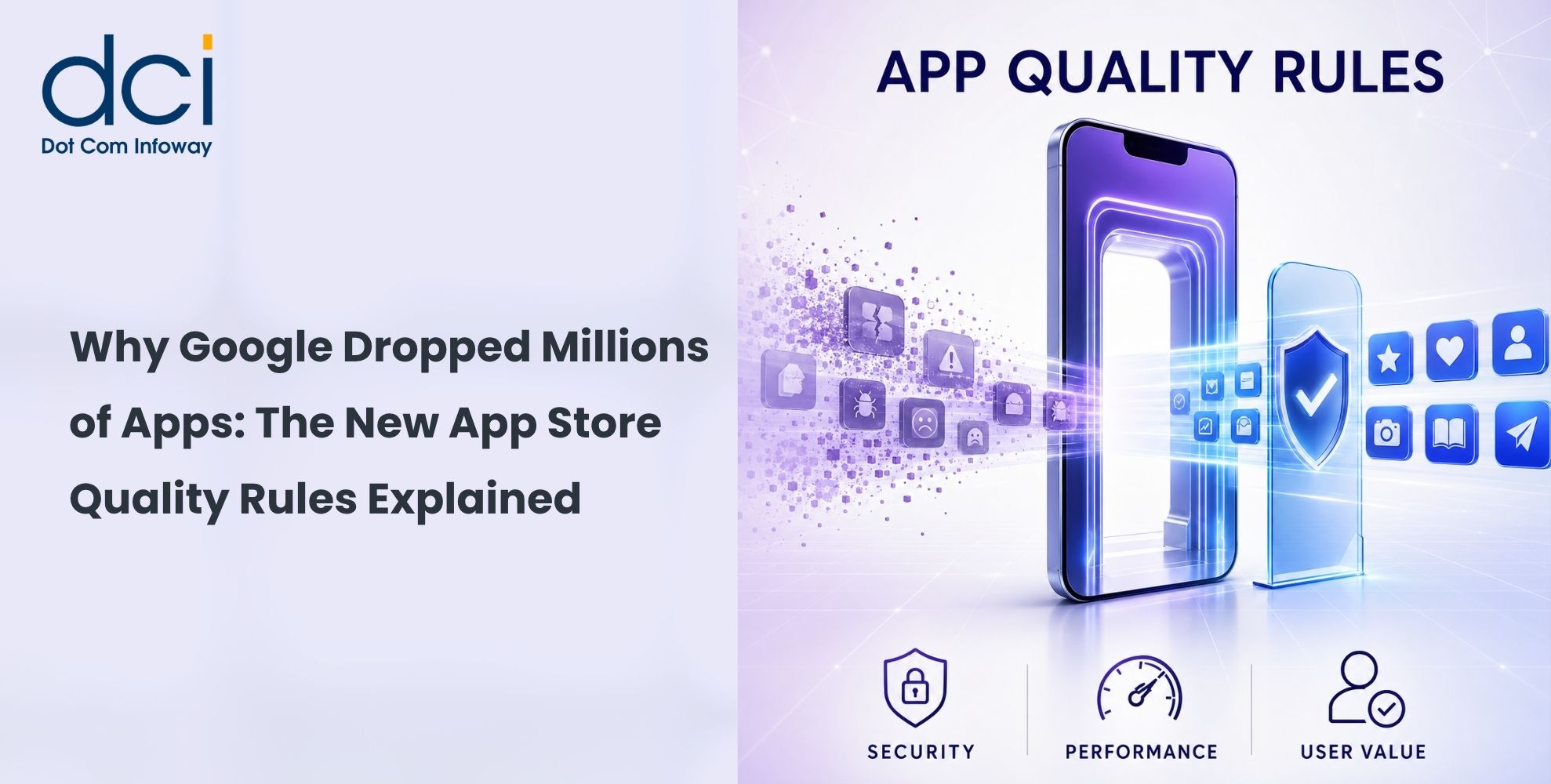
The Google Play App Quality Rules are changing what it takes for an Android app to remain visible, compliant and competitive. According to Appfigures, Google Play’s worldwide app inventory declined from approximately 3.4 million apps at the beginning of 2024 to around 1.8 million in 2025, a fall of roughly 47%. The decline reflects stronger enforcement, developer verification, testing requirements and the disappearance of abandoned or low-value applications.

For businesses, the message is clear: publishing an Android app is no longer enough. Applications must provide meaningful functionality, technical stability, transparent data practices and genuine user value.

.Why Google Dropped Millions of Apps: The New App Store Quality Rules Explained

Why Did Google Play’s App Count Fall So Sharply?

    Google Play’s open ecosystem helped millions of developers reach Android users. However, it also created large numbers of abandoned apps, repetitive products, static-content applications and apps offering little more than a website inside a mobile interface.

    Google’s Functionality, Content and User Experience policy requires applications to be stable, responsive and engaging. Apps containing only static text, PDFs, single wallpapers or extremely limited functionality may fail to meet these requirements.

    Applications facing the greatest risk include:

    • Apps with little meaningful functionality or interaction.
    • Duplicate or repetitive applications offering minimal original value.
    • Poorly maintained apps that crash, freeze or fail to load correctly.

    App quality is therefore becoming a core development requirement rather than simply a Play Store submission consideration.

    Google’s Enforcement Numbers Show the Scale

    Google reported that in 2024 it prevented 2.36 million policy-violating apps from being published and banned more than 158,000 developer accounts linked to harmful activity.

    In 2025, Google said it prevented more than 1.75 million policy-violating apps from reaching Google Play and banned over 80,000 bad developer accounts.

    These figures are separate from the reported 47% decline in total app inventory, but together they show how aggressively Google is raising its standards.

        What Developers Need to Change

        The Google Play App Quality Rules increasingly require quality assurance to begin before an app reaches the publishing stage.

        Personal developer accounts created after November 13, 2023 must complete a closed test before receiving production access. Google currently requires at least 12 testers to remain opted in continuously for 14 days before developers can apply for production access.

        Testing should therefore go beyond successful installation. Businesses must verify whether users can understand the app, complete primary actions and use important features without technical barriers.

        A strong development process should combine user-experience planning, performance testing, security, privacy compliance and scalability. DCI’s Mobile App Development Guide: From Idea to Scalable App explains how businesses can connect app strategy, development and long-term scalability.

        Android 16 Requirements Make Maintenance Critical

        From August 31, 2026, new Android applications and updates submitted to Google Play must generally target Android 16, API level 36.

        Existing mobile applications generally need to target at least Android 15, API level 35 to remain available to new users running Android versions newer than the application’s target level.

        Google also provides an extension pathway until November 1, 2026 for eligible developers requiring additional migration time.

        Businesses should review:

        • Target API levels and Android compatibility.
        • Android vitals, crashes, ANRs and performance.
        • Data Safety declarations, permissions and privacy disclosures.
        • Third-party SDKs, analytics tools and AI integrations.
        • Play Store descriptions, screenshots and feature accuracy.

        App Quality Now Influences Discoverability

        Getting an application approved does not guarantee that users will find it.

        Google increasingly evaluates behavioural and technical signals such as user loss, daily active users, monthly active users, crashes, usability and feature depth.

        For some Play quality treatments, Google references benchmarks including a user-loss rate below 5% and a DAU-to-MAU ratio above 8%.

        Android vitals can also affect discoverability. Apps with excessive crash or ANR rates may experience reduced visibility on Google Play.

        This means development and App Store Optimization must work together. An optimized title and strong screenshots may attract users, but poor performance or low retention can weaken long-term growth.

        DCI’s Why Your App Isn’t Ranking in the App Store & How ASO Can Fix It explains how keywords, metadata, ratings, downloads and retention influence app-store rankings.


                mobile-design-300x300

                Is your app ready for the new app store quality rules?
                Our app development and app marketing experts can help improve your app’s performance, compliance, visibility, and user experience-so it stays competitive in today’s stricter app marketplace. Contact us today for a consultation.


                What a Cleaner Play Store Means for Businesses

                Higher quality thresholds may benefit serious app publishers by reducing competition from inactive, repetitive and extremely low-value applications.

                Businesses maintaining technically healthy apps are more likely to build trust and sustainable organic visibility.

                App Store Optimization should also begin before launch. Product functionality, screenshots, descriptions, reviews and user expectations should communicate the same value proposition.

                DCI’s guide on Why App Store Optimization Is the Key to Driving Organic App Downloads explains how businesses can strengthen sustainable app discovery.

                      What Should Businesses Do Now?

                      Existing Android apps should undergo a technical, policy, and growth audit aligned with Google Play App Quality Rules. Businesses should check API compatibility, SDK dependencies, Android vitals, permissions, Data Safety details, functionality, retention metrics, and Play Store listings.

                      For new applications, teams should first ask: What valuable task can users accomplish through this app? If an app provides little more than information already available on a website, its mobile functionality may need to be strengthened before further investment.

                        Frequently Asked Questions

                        Why did Google Play lose nearly half of its apps?

                        Appfigures reported a decline from approximately 3.4 million apps at the beginning of 2024 to around 1.8 million in 2025. Stronger quality standards, verification, testing and policy enforcement contributed to the change.

                        Can Google remove apps with limited functionality?

                        Applications offering insufficient functionality or poor user experiences can violate Google’s policies. Static-text, PDF-only and extremely limited applications are among the examples identified in Google’s guidance.

                        Will outdated Android apps automatically disappear after August 31, 2026?

                        Not necessarily. However, apps that fail to meet target API requirements may become unavailable to new users running newer Android versions.

                        Final Thoughts

                        Google Play’s dramatic reduction in app inventory reflects a broader change in mobile publishing. Technical performance, genuine functionality, testing, privacy, Android compatibility and engagement are increasingly part of the same quality framework.

                        For businesses, the direction is clear: build applications that solve meaningful user needs, keep them technically current and continuously optimize both the product experience and Play Store visibility.

                        As Google’s standards rise, well-maintained apps with strong user value have a better opportunity to stand out. However, quality alone does not guarantee downloads or retention. A strong growth strategy combining ASO, user acquisition, engagement and performance marketing is equally important.

                        Dot Com Infoway’s App Marketing Services help businesses improve app visibility, attract high-quality users and build sustainable growth across competitive app marketplaces.

                        Latest Posts

                        Get the latest insights from Dot Com Infoway straight to your inbox.