5. Inaccurate Conversion Tracking
Sometimes, businesses may be generating sales or enquiries, but their advertising platforms fail to record them accurately.
Businesses should regularly verify:
- Purchase and lead conversion events.
- Google Ads conversion tracking.
- Google Analytics 4 event configuration.
- Meta Pixel and Conversions API implementation.
- Duplicate or missing conversion events.
Accurate conversion tracking provides a stronger foundation for campaign optimization and informed budget allocation.
Key Advertising Metrics Businesses Should Monitor Beyond Clicks
While clicks and impressions help measure advertising visibility, they do not provide a complete understanding of campaign effectiveness.
Businesses should monitor the following performance indicators:
- Click-Through Rate : Measures how frequently users click an advertisement after seeing it.
- Cost Per Click : Indicates the average amount spent to generate a click.
- Conversion Rate: Measures the percentage of relevant interactions or visits that result in a desired action.
- Cost Per Acquisition : Identifies the average cost of generating a customer or conversion.
- Return on Ad Spend : Measures the revenue generated relative to advertising expenditure.
- Cart Abandonment Rate: Identifies how frequently shoppers add products to their carts without completing a purchase.
- Customer Lifetime Value : Estimates the long-term value a customer contributes to a business.
Monitoring these metrics together helps businesses evaluate whether their advertising campaigns are generating meaningful results rather than simply increasing website traffic.
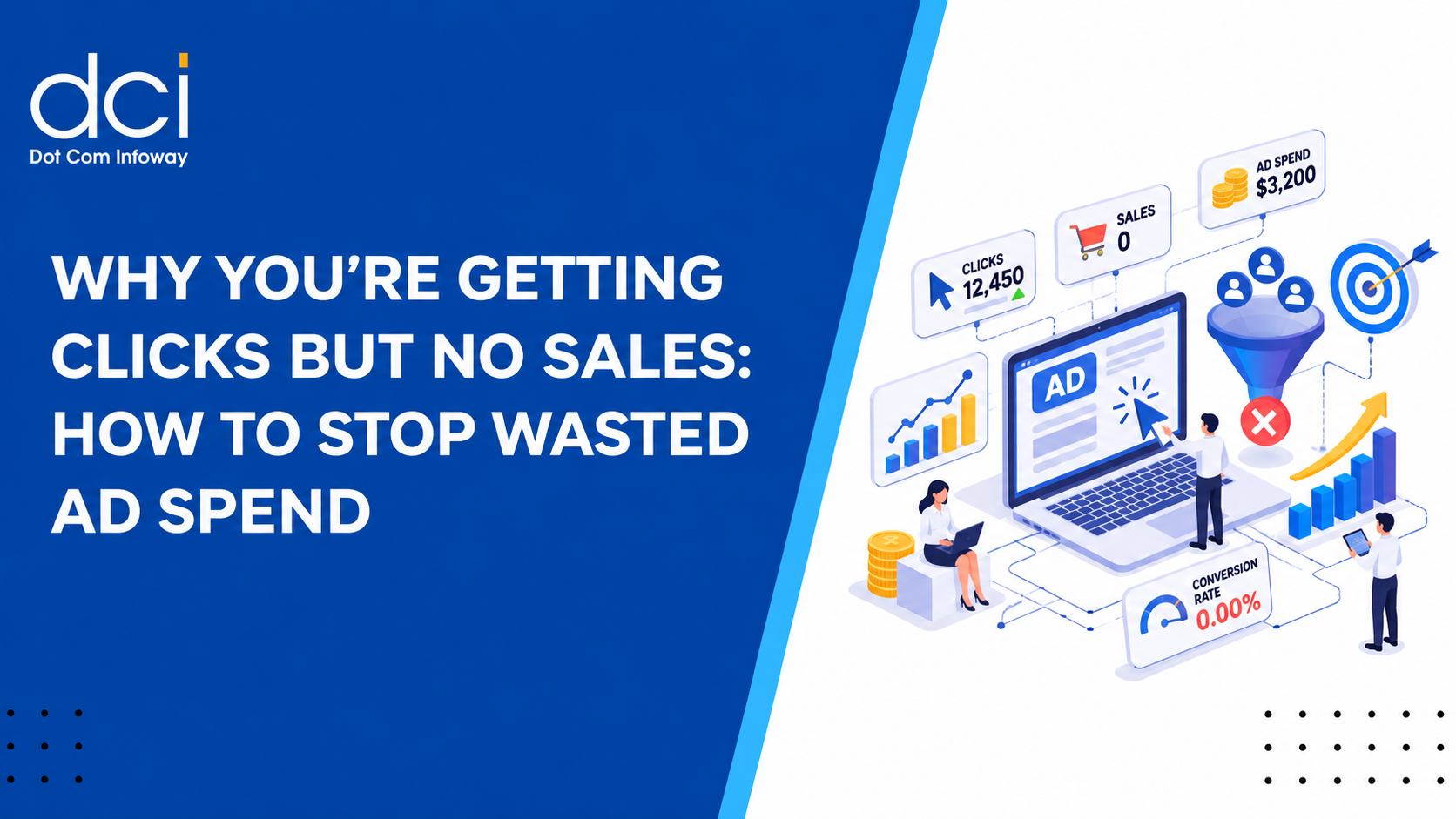
Clicks but No Sales: Where Is Your Ad Budget Being Wasted?
Wasted ad spend does not always result from poor advertisements. It can occur at multiple stages of the marketing funnel, from audience acquisition to the final purchase.
1. Advertising to Low-Quality Traffic
Generating more website visitors is not always beneficial if those visitors are unlikely to become customers.
Businesses should:
- Review search term reports.
- Exclude irrelevant keywords.
- Evaluate audience performance.
- Monitor geographic and device-level performance.
- Review advertising placements.
- Reduce spending on consistently underperforming segments.
These improvements help businesses focus their advertising budgets on audiences with stronger conversion potential.
2. Focusing on Clicks Instead of Conversions
Campaigns optimized primarily for traffic may attract users who frequently click advertisements but are less likely to complete a purchase.
Businesses should align their campaign objectives with their actual business goals, whether those goals involve product purchases, qualified enquiries, registrations, or subscriptions.
3. Ignoring Existing Website Visitors
Not every potential customer makes a purchase during their first website visit. Some users need additional information, product comparisons, or reassurance before making a decision.
Retargeting campaigns can help businesses reconnect with:
- Previous website visitors.
- Product page visitors.
- Cart abandoners.
- Users who started but did not complete registration.
- Potential customers who engaged with previous advertisements.
How to Fix Clicks but No Sales and Improve Conversions
Rather than increasing advertising budgets immediately, businesses can follow a structured optimization process to improve existing campaign performance.
1. Conduct a Paid Advertising Audit
Review campaign settings, targeting, keywords, placements, bidding strategies, and conversion tracking to identify areas where advertising budgets are being used inefficiently.
2. Improve Audience Targeting
Use customer data and campaign performance insights to identify high-value audience segments. Refine targeting based on customer behaviour, demographics, and purchase intent.
3. Optimize Landing Pages
Improve website speed, mobile usability, product descriptions, trust signals, and calls to action. Ensure landing page content remains consistent with the advertisement.
4. Refine Keyword Targeting
Prioritize relevant commercial and transactional keywords while reviewing search term reports and adding negative keywords to reduce irrelevant clicks.
5. Test Different Advertising Creatives
Conduct A/B testing with different headlines, images, offers, calls to action, and messaging to identify which combinations generate stronger conversion results.
6. Optimize Campaigns for Business Outcomes
Select campaign objectives and bidding strategies that align with purchases, qualified leads, or other meaningful business outcomes. Ensure conversion tracking is reliable before relying on automated optimization.
7. Reallocate Advertising Budgets
Evaluate campaign performance using conversion rates, CPA, ROAS, and profitability. Gradually redirect budgets toward campaigns and audience segments that deliver sustainable business results.
8. Monitor and Optimize Regularly
Paid advertising optimization is an ongoing process. Regularly review campaign performance, customer behaviour, and market changes to identify new opportunities and prevent unnecessary spending.
How to Identify Why You’re Getting Clicks but No Sales
The right optimization strategy depends on where customers are dropping off during their purchase journey.
- High clicks but low engagement: Review audience targeting, keyword relevance, and landing page experience.
- High engagement but few product purchases: Evaluate pricing, product information, customer trust, and purchase incentives.
- High add-to-cart rates but low sales: Examine checkout usability, shipping costs, payment options, and return policies.
- High advertising costs but low ROAS: Review campaign efficiency, customer acquisition costs, and budget allocation.
- Recorded sales but missing advertising conversions: Verify conversion tracking and attribution settings.
Identifying the specific problem helps businesses avoid unnecessary campaign changes and focus on improvements that are more likely to increase conversions.
Frequently Asked Questions
1. Why am I getting clicks but no sales on my website?
This may happen because of poor audience targeting, low purchase intent, ineffective landing pages, high product pricing, complicated checkout processes, or inaccurate conversion tracking. Reviewing the entire customer journey helps identify the underlying issue.
2. Why are my Google Ads getting clicks but no conversions?
Google Ads campaigns may generate clicks without conversions when they target irrelevant search terms, low-intent keywords, or unsuitable audiences. Landing page issues and incorrect conversion tracking can also contribute to poor performance.
3. Why are my Facebook Ads not generating sales?
Facebook Ads may fail to generate sales because of ineffective audience targeting, weak advertising creatives, unsuitable campaign objectives, or a poor website purchasing experience. Testing and optimizing these areas can help improve results.
4. How can I reduce wasted ad spend?
Businesses can reduce wasted ad spend by improving audience targeting, excluding irrelevant keywords, optimizing landing pages, implementing accurate conversion tracking, and reallocating budgets based on meaningful performance data.
Final Thoughts
Getting clicks but no sales is often a sign that businesses need to evaluate their advertising strategy beyond traffic generation. From audience targeting and keyword selection to landing page optimization and checkout experience, every stage of the customer journey contributes to campaign performance.
At Dot Com Infoway, we help businesses improve their digital advertising performance through strategic campaign management, audience optimization, and conversion-focused digital marketing solutions. By focusing on meaningful business outcomes rather than clicks alone, businesses can make better use of their advertising budgets and drive sustainable growth.