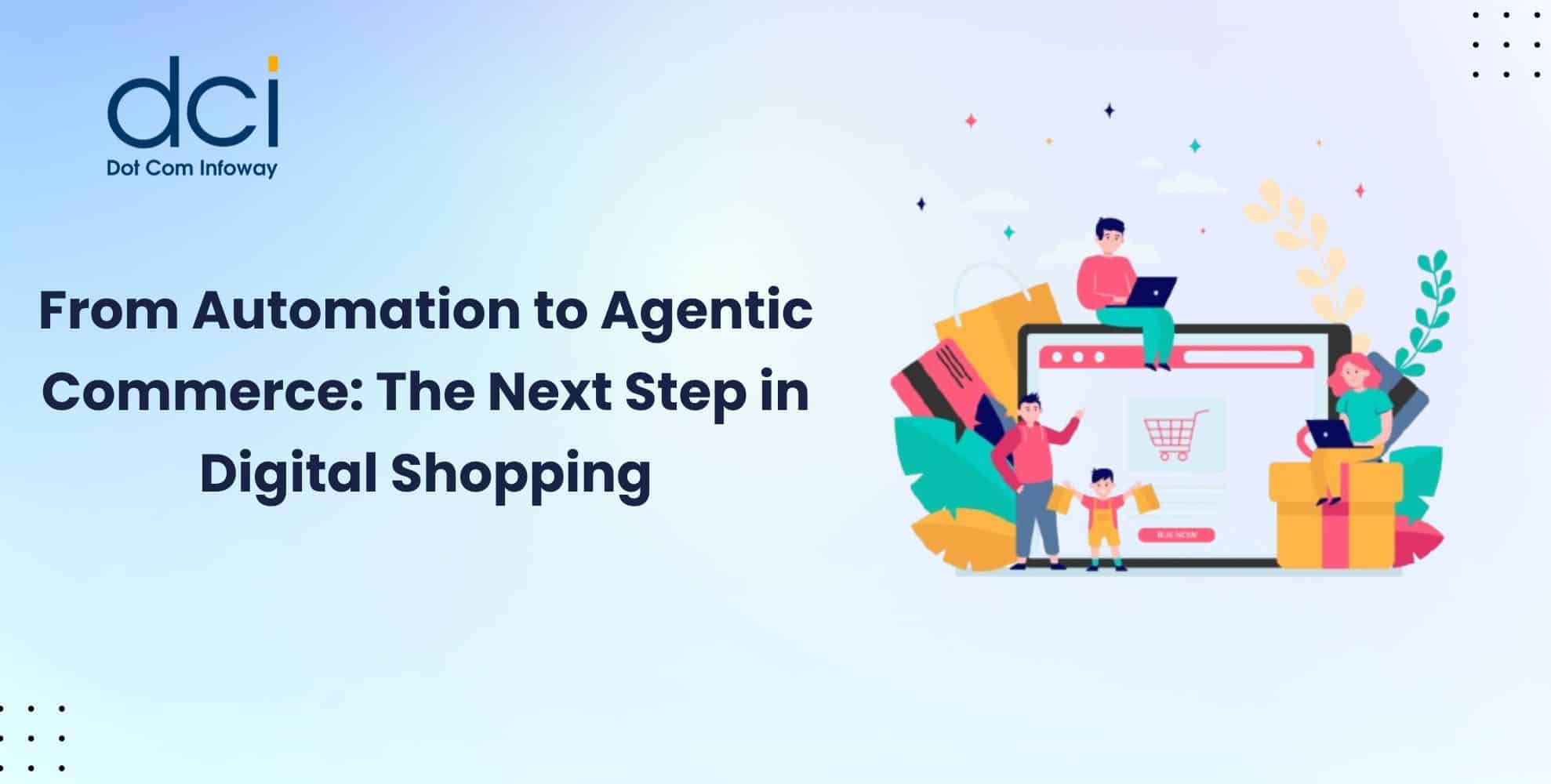
From Automation to Agentic Commerce: The Next Step in Digital Shopping

By

7 mins read

Digital marketers and eCommerce businesses are hitting a ceiling with traditional automation. While automation has streamlined operations and reduced manual effort, it no longer delivers the level of intelligence required to compete in today’s fast-paced digital ecosystem.

This is where Automation to Agentic Commerce becomes a game-changer. Instead of relying on static workflows, businesses are adopting AI-driven systems that can think, decide, and act in real time. As customer expectations shift toward hyper-personalization and instant engagement, agentic commerce is rapidly becoming the new benchmark for success.

From Automation to Agentic Commerce: The Next Step in Digital Shopping

What Is Agentic Commerce?

    Agentic commerce refers to AI-powered systems that can independently manage and optimize the entire customer journey-from product discovery to final purchase and even post-sale engagement.

    Unlike traditional automation, these systems continuously learn from user behavior, adapt to changing contexts, and execute decisions without manual intervention. This enables businesses to deliver more personalized, relevant, and timely experiences.

    Core Capabilities:

    • Autonomous decision-making
    • Context-aware personalization
    • Continuous learning through AI models
    • End-to-end execution

    This transformation is central to the evolution from Automation to Agentic Commerce, where intelligence replaces rigid rule-based systems.

    Automation vs Agentic Commerce: Understanding the Difference

    Traditional automation is built on predefined rules and workflows, making it effective for repetitive tasks but limited in handling complex, dynamic user behavior. It often requires constant manual updates to stay relevant.

    Agentic commerce, in contrast, leverages AI to understand user intent, predict outcomes, and take proactive actions. These systems continuously improve through data, enabling businesses to deliver highly personalized and efficient customer experiences at scale.

    According to McKinsey, companies implementing AI-driven personalization strategies have reported up to a 15% increase in revenue and a 20% improvement in marketing efficiency. This highlights why the shift toward Automation to Agentic Commerce is becoming a strategic priority.

    Why Businesses Are Moving Toward Agentic Commerce

    The transition toward agentic commerce is being driven by a combination of changing consumer expectations, increasing data complexity, and the need for real-time responsiveness.

    Today’s consumers expect brands to understand their preferences and deliver relevant experiences instantly. At the same time, businesses are generating vast amounts of data that require intelligent systems to extract actionable insights.

    Agentic systems address these challenges by enabling predictive personalization, real-time engagement, and automated decision-making. This makes the shift from Automation to Agentic Commerce not just beneficial, but essential for long-term growth.

    Real-World Examples Driving Agentic Commerce

    Amazon: Intelligent Product Recommendations

    Amazon’s AI-powered recommendation engine contributes to nearly 35% of total sales, demonstrating how intelligent systems can analyze user behavior in real time and deliver highly relevant product suggestions. This is a strong example of automation evolving into agentic decision-making.

    Netflix: Hyper-Personalized User Experience

    Netflix uses advanced AI algorithms to predict user preferences based on viewing history and engagement patterns. This level of personalization increases retention and engagement, showcasing how agentic principles can be applied beyond eCommerce and adapted into digital shopping experiences.

    Shopify: AI-Enhanced Merchant Tools

    Shopify integrates AI-driven features that help merchants automate marketing campaigns, optimize product listings, and enhance customer interactions. These capabilities enable businesses to move beyond static automation and adopt more intelligent, adaptive commerce strategies.

    How Agentic Commerce Improves Conversions

    Agentic commerce directly impacts conversion rates by optimizing every stage of the customer journey. Instead of delivering generic experiences, it uses real-time data and predictive analytics to create highly personalized interactions.

    Key Conversion Drivers:

    • Hyper-personalization increases engagement and purchase likelihood
    • Predictive analytics identifies high-intent users
    • Automated workflows reduce friction and drop-offs

    Gartner predicts that by 2026, 80% of customer interactions will be managed by AI, making intelligent commerce systems a critical component of business success.


    mobile-design-300x300

    Looking to boost engagement and sales with less manual effort?
    Agentic commerce uses intelligent systems to automate decisions and personalize customer experiences in real time.This helps increase engagement and drive more sales while reducing manual effort.


    The Role of AI Services in Agentic Commerce

    AI services are the foundation of agentic commerce, enabling systems to process large volumes of data, understand user intent, and make intelligent decisions.

    Technologies such as machine learning, natural language processing, and predictive analytics allow businesses to automate complex processes while maintaining a high level of personalization. These capabilities empower organizations to deliver seamless customer experiences and optimize operations at scale.

    As adoption of AI services continues to grow, the transition from Automation to Agentic Commerce becomes more achievable and impactful.

    Challenges in Implementing Agentic Commerce

    Despite its advantages, implementing agentic commerce comes with several challenges. Many businesses face difficulties in integrating data across multiple platforms, while others struggle with the high initial investment and lack of technical expertise.

    Data privacy and compliance are also critical considerations, especially as companies handle increasing volumes of customer information. Addressing these challenges requires a strategic approach that includes scalable solutions, proper data governance, and collaboration with experienced partners.

    Working with industry experts like Dot Com Infoway can help businesses navigate these complexities and accelerate their journey toward intelligent commerce systems.

    How to Transition from Automation to Agentic Commerce

    A phased and strategic approach is essential for a successful transition.

    Step-by-Step Approach:

    • Audit existing automation systems to identify gaps
    • Integrate AI services into key customer touchpoints
    • Implement intelligent agents for decision-making
    • Continuously monitor, analyze, and optimize performance

    This structured roadmap enables businesses to move efficiently toward Automation to Agentic Commerce while maximizing ROI.

    Future Trends Shaping Agentic Commerce

    The future of digital commerce will be driven by increasingly advanced AI technologies. Businesses are already exploring voice-enabled shopping experiences, autonomous purchasing agents, and real-time dynamic pricing models.

    As AI continues to evolve, these innovations will create more seamless and intuitive shopping journeys. According to Statista, the global AI retail market is expected to reach $45 billion by 2030, highlighting the massive growth potential in this space.

    The Road Ahead for Digital Commerce

    The shift from Automation to Agentic Commerce marks a fundamental transformation in how businesses engage with customers and drive growth. It is no longer enough to automate processes-companies must adopt systems that can think, learn, and act independently.

    By leveraging advanced AI services and partnering with experts like Dot Com Infoway, businesses can build intelligent commerce ecosystems that deliver personalized, real-time experiences at scale. Those who embrace this transformation today will not only meet evolving customer expectations but also secure a strong competitive advantage in the future of digital shopping.

    Latest Posts

    Get the latest insights from Dot Com Infoway straight to your inbox.

    Please enable JavaScript in your browser to complete this form.