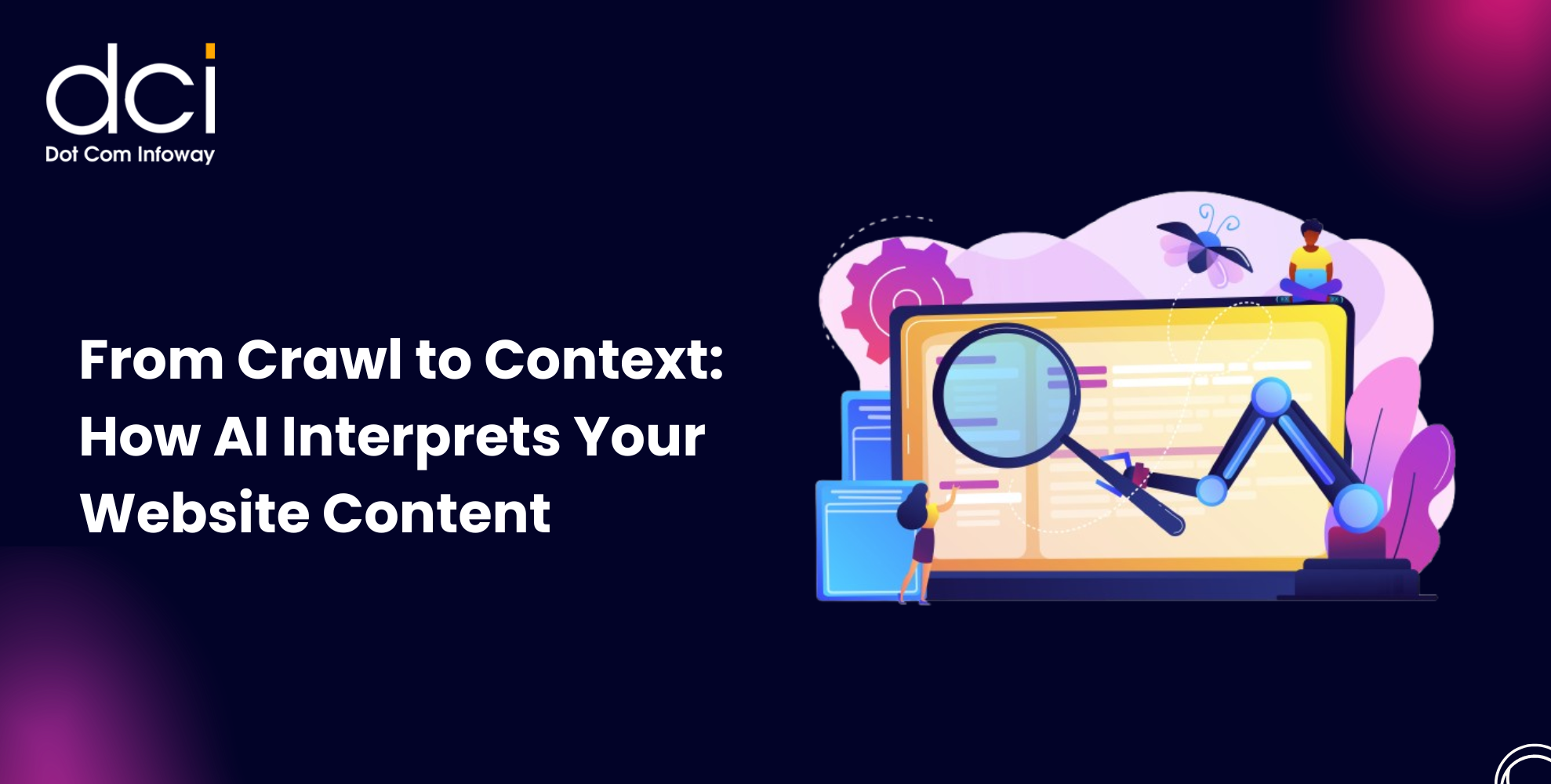
From Crawl to Context: How AI Interprets Your Website Content

By

8 mins read

Many businesses today face a surprising challenge. Even though their website ranks on traditional search engines, it often fails to appear in answers generated by AI platforms like ChatGPT, Google Gemini, or Perplexity AI. This happens because AI interprets website content differently than traditional search engines. As search behavior shifts toward conversational AI, this visibility gap is becoming a serious concern for digital marketers.

The reason lies in how AI interprets website content. Unlike traditional search engines that rely heavily on keyword signals and backlinks, AI-driven search systems analyze meaning, structure, and contextual relationships within content. If a website lacks clear structure or machine-readable signals, AI systems may struggle to interpret it effectively.

This is why many organizations now invest in AI search optimization and specialized LLM SEO services to ensure their content can be understood and referenced by large language models. Companies like Dot Com Infoway are already helping brands adapt to this shift by improving their AI-ready SEO frameworks.

Understanding how AI systems crawl, process, and interpret your website content is now essential for maintaining digital visibility.

From Crawl to Context: How AI Interprets Your Website Content

The Evolution of Search: From Crawling to Context

    Traditional search engines begin their process by crawling and indexing web pages. Crawlers scan the HTML structure of a page and store it in an index so it can be retrieved when users search for relevant keywords.

    However, modern AI-powered search platforms go beyond indexing. They attempt to understand the meaning behind content before presenting answers to users.

    The process typically involves three stages:

    • Crawling the webpage and retrieving its raw content
    • Parsing the page structure, headings, and internal links
    • Interpreting contextual meaning using large language models

    At the final stage, AI Interprets relationships between topics, entities, and questions. Instead of simply ranking pages, AI systems extract information and generate direct responses to user queries.

    For marketers, this means that content must be structured and context-rich so that AI models can clearly interpret its meaning.

    What AI Crawlers Actually See on Your Website

    Many websites are designed primarily for human readers, but AI crawlers experience them very differently. Most AI systems analyze the raw HTML response of a page rather than the fully rendered visual layout.

    Technical elements such as JavaScript-heavy frameworks or dynamically loaded content can limit what AI bots are able to access. When important information is hidden behind scripts or poorly structured markup, it may not be visible to crawlers.

    This limitation is one of the most common causes of AI search visibility issues.

    For example, websites that rely heavily on client-side rendering often make it difficult for crawlers to retrieve meaningful content. If the structure of the page is unclear, the system may struggle to determine the topic or importance of different sections.

    As a result, even high-quality content can fail to appear in AI-generated answers.

    How AI Interprets Content Semantically

    After retrieving the page content, the AI begins analyzing its meaning. This is the stage where AI Interprets the relationships between topics, entities, and user questions.

    Unlike traditional SEO, which focuses largely on keyword matching, AI-driven systems rely on semantic understanding. They evaluate whether the content clearly explains a topic, supports related concepts, and provides contextual clarity.

    Several factors influence how effectively AI Interprets a page:

    • Contextual relationships between topics and subtopics
    • Logical heading structure that organizes information clearly
    • Question-and-answer sections that match common user queries
    • Internal links connecting related content

    When these elements are present, AI systems are more likely to recognize the page as a reliable source of information.

    Conversely, content that lacks structure or semantic clarity may be ignored by AI answer engines.

    The Importance of Structured Data for AI SEO

    One of the most effective ways to improve how AI Interprets website content is through structured data for AI SEO. Structured data provides machine-readable information that helps search engines and AI models understand the context of a page.

    Schema markup can define key elements such as articles, FAQs, products, or organization details. These signals help AI systems identify the purpose and relevance of specific sections of content.

    For example, FAQ schema enables AI platforms to quickly detect question-and-answer segments within a page. This makes it easier for AI systems to extract relevant information and present it in conversational responses.

    Without structured data, AI systems must rely solely on natural language interpretation, which increases the risk of misinterpretation. Implementing structured schema improves both search engine indexing and AI-driven discoverability.


    mobile-design-300x300

    What happens after AI crawls your website?
    Ensure your content provides clear context and structure so AI can interpret it accurately and improve your search visibility.


    LLM.txt and Emerging AI Crawling Standards

    As AI search continues to evolve, new technical standards are emerging to help websites communicate more effectively with language models.

    One such concept is LLM.txt for AI crawling, which functions similarly to robots.txt but is designed specifically for AI systems. This file can provide instructions about how AI models should access and interpret website content.

    Using LLM.txt for AI crawling, website owners may eventually be able to:

    • Highlight important content sections
    • Provide summarized descriptions for AI indexing
    • Guide how AI models reference their information

    Although still an emerging practice, this approach represents the next stage of AI-focused technical SEO.

    Addressing AI Search Visibility Challenges

    The rise of AI-powered search has introduced a new category of SEO challenges. Many websites that perform well in traditional search results still struggle with AI search visibility issues.

    Common causes include poorly structured content, lack of semantic organization, missing schema markup, and weak internal linking architecture.

    To improve ChatGPT search visibility and other AI-driven platforms, businesses should focus on building content that is both human-readable and machine-interpretable.

    Organizations increasingly rely on LLM SEO services to implement these strategies effectively. Agencies such as Dot Com Infoway specialize in helping brands restructure their content and technical architecture to support modern AI search environments.

    The Future of Search: From Ranking to Referencing

    Search is rapidly evolving from a ranking-based model to a reference-based model. Instead of displaying a list of links, AI platforms generate answers by synthesizing information from trusted sources.

    This transformation means that content must be optimized not only for search engines but also for how AI Interprets information. Websites that provide structured, authoritative, and context-rich content are far more likely to be cited in AI responses.

    Businesses that adapt their strategies toward AI search optimization, structured data implementation, and semantic content design will gain a significant advantage in this new landscape.

    In the era of AI-powered discovery, visibility will increasingly belong to websites whose content AI systems can clearly understand, interpret, and trust.

    Latest Posts

    Get the latest insights from Dot Com Infoway straight to your inbox.

    Please enable JavaScript in your browser to complete this form.