



Your organic traffic is dropping, and you can’t figure out why. Your rankings look fine. Your content is solid. Yet something fundamental has shifted, and it’s happening right above your carefully optimized search results. AI-generated answers are quietly eating your clicks. According to Gartner, traditional organic search traffic will decline by 25% by 2026 as users increasingly rely on AI-powered answers from tools like ChatGPT, Gemini, and Perplexity. The search landscape isn’t just evolving; it’s being rebuilt from the ground up. For businesses navigating this shift, adapting content and visibility strategies through GEO services is quickly becoming a critical step to avoid being pushed out of the conversation altogether.
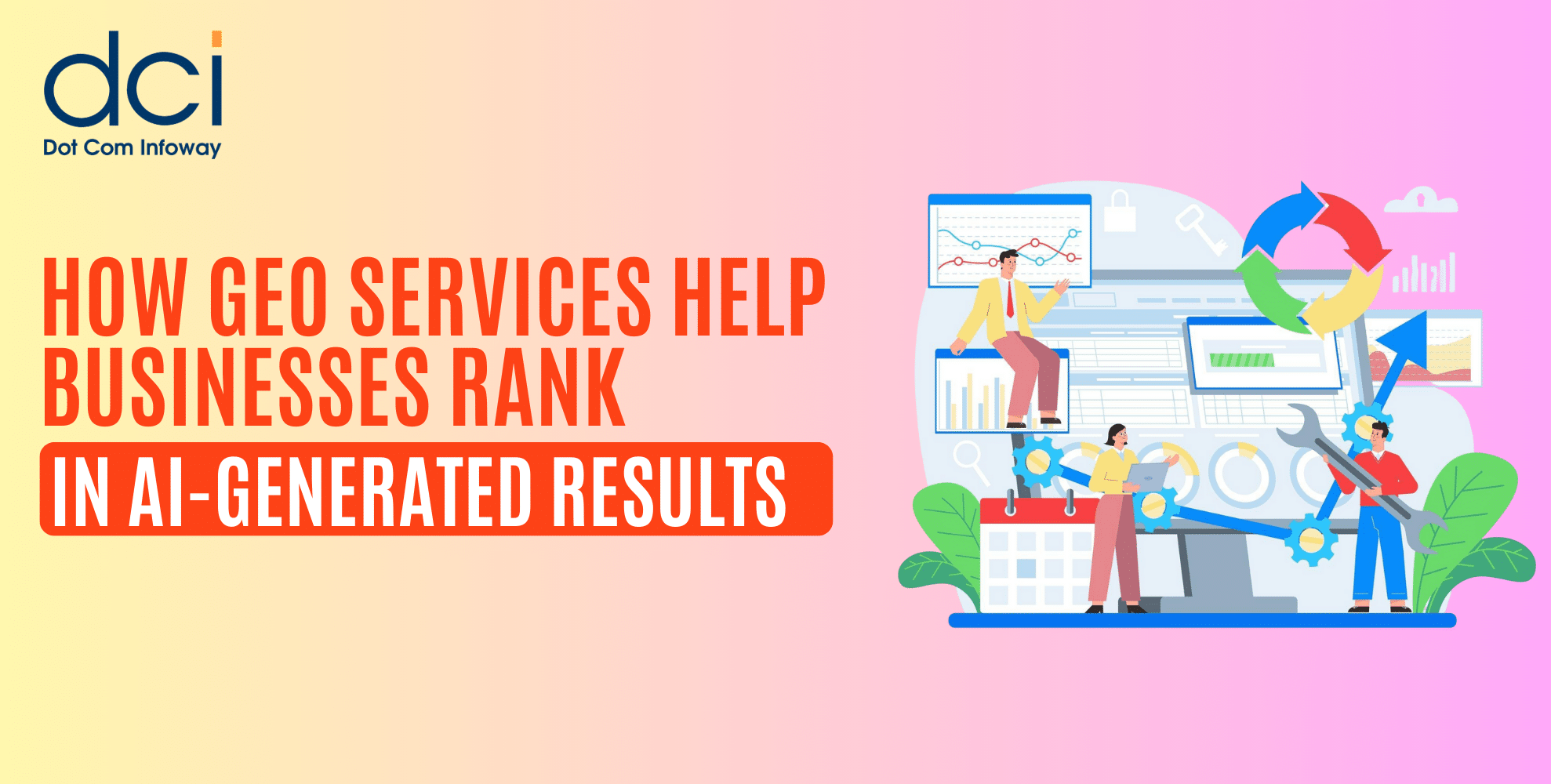
How GEO Services Help Businesses Rank in AI-Generated Results
8 mins read
What Exactly Are GEO Services?
Generative Engine Optimization (GEO) represents the next evolution of search visibility. While traditional SEO focuses on ranking in Google’s blue links, GEO services specifically optimize your content to appear in AI-generated responses across platforms like ChatGPT, Google’s Gemini, Perplexity AI, and DeepSeek.
Think of it this way: SEO helps you rank. GEO helps you get cited.
- Generative Engine Optimization is the practice of optimizing content to improve its visibility in AI-generated responses, ensuring brands are referenced when LLMs synthesize information for users.
- The distinction matters because AI engines don’t display results the same way traditional search does. They synthesize, summarize, and cite. If your content isn’t structured to be understood and referenced by large language models (LLMs), you’re invisible in this new paradigm, regardless of how well you rank on Google.
How AI Search Engines Process Information Differently
Understanding how AI platforms select sources is crucial before implementing any optimization strategy.
ChatGPT relies on training data and, with browsing enabled, pulls from authoritative web sources in real-time. It favors content with clear definitions, structured data, and semantic precision. Google Gemini integrates deeply with Google’s knowledge graph and prioritizes content that already performs well in traditional search, though it applies additional AI-readability criteria. Perplexity AI operates more like a research assistant, actively crawling the web and citing multiple sources within its answers: making citation-worthy formatting essential. DeepSeek, emerging from China’s AI landscape, processes content similarly but with particular emphasis on technical accuracy and data-backed claims.
What unites these platforms? They all reward content that demonstrates expertise, provides verifiable information, and presents ideas with semantic clarity that machines can parse efficiently.
A groundbreaking Princeton University study found that content optimized using GEO principles saw visibility improvements of up to 40% in AI-generated responses. That’s not a marginal gain: it’s the difference between being cited and being ignored.
Core Tactics That Make GEO Services Effective
Professional GEO services employ several interconnected strategies that traditional SEO agencies often overlook. Here’s what actually moves the needle:
Semantic Clarity and Entity Optimization
AI engines understand concepts through entities: people, places, organizations, and ideas. Your content needs to clearly establish what entities you’re discussing and how they relate to each other. This means moving beyond keyword density toward conceptual precision. When you mention your company, product, or service, define it explicitly. Don’t assume context; provide it.
Technical Citations and Data Integration
LLMs prioritize sources that include verifiable statistics, research citations, and expert quotes. Generic claims get filtered out. Specific, attributed data gets referenced. This is why content featuring original research, industry benchmarks, or expert interviews consistently outperforms purely opinion-based pieces in AI-generated responses.
Pages with statistics, citations from credible sources, and structured expertise signals are significantly more likely to be referenced in AI Overviews and generative search results.
Authoritative Formatting Structures
How you format content directly impacts AI readability. Clear heading hierarchies, definition-style explanations, FAQ schemas, and summary sections all help LLMs extract and cite your information accurately. It’s not about gaming the system: it’s about making your expertise accessible to machines that need to synthesize thousands of sources quickly.
The Real-World Impact on Business Visibility
Let’s talk numbers, because theory only matters if it translates to results.
Google’s AI Overviews now appear in approximately 40% of local searches, according to recent industry analyses. When these overviews appear, they occupy prime real estate at the very top of results: pushing traditional organic listings significantly lower. For businesses not optimized for this format, the practical impact is devastating: fewer clicks, lower engagement, diminished brand visibility.
But here’s the opportunity that smart marketers are seizing: businesses featured in AI Overviews report substantially higher conversion rates compared to traditional organic traffic. Why? Because users who click through from AI-generated summaries have already been pre-qualified by the AI’s recommendation. They’re not browsing; they’re buying.
Companies investing in GEO services early are establishing competitive moats that will be increasingly difficult to overcome. As AI search adoption accelerates, the brands referenced today will maintain citation momentum tomorrow: a compounding advantage that mirrors early SEO adoption two decades ago.

Ready to boost your website’s rankings and online visibility?
Discover how our expert SEO services can resolve ranking issues, drive traffic, and elevate your website’s performance to the next level!
Why Traditional SEO Isn’t Enough Anymore
This isn’t about abandoning SEO. Your Google rankings still matter. Your technical foundation still matters. But treating SEO as your complete visibility strategy in 2026 is like optimizing for desktop while ignoring mobile in 2015.
The search ecosystem has bifurcated. Traditional search now primarily serves navigational and transactional queries. Meanwhile, AI-powered search dominates informational queries: precisely where most content marketing efforts live.
GEO services bridge this gap by ensuring your content performs across both paradigms. The best practitioners don’t treat GEO and SEO as separate disciplines; they integrate them into a unified visibility strategy that captures traffic regardless of how users choose to search.
Preparing Your Business for AI-First Search
The businesses winning in AI-generated results share common characteristics worth emulating. They publish original research and proprietary data that can’t be found elsewhere. Leading brands also structure content with explicit definitions and clear entity relationships. At the same time, they maintain consistent expertise signals across their digital presence. And they regularly audit how their content appears in AI-generated responses: not just traditional search results. This isn’t a future trend to monitor. It’s a present reality demanding immediate attention.
The question isn’t whether AI will transform search: it’s whether your business will be cited when it does. Early movers in GEO services adoption are already seeing measurable improvements in AI visibility, brand mentions, and qualified traffic. The window for establishing competitive advantage is open, but it won’t stay that way indefinitely.
Conclusion
Navigating this transition requires expertise that blends traditional digital marketing knowledge with emerging AI optimization techniques. Whether you’re looking to audit your current AI visibility, develop a comprehensive GEO strategy, or integrate these capabilities into existing marketing efforts, partnering with specialists who understand both paradigms is essential.
If you’re ready to future-proof your digital presence, Dot Com Infoway’s digital marketing services offer the strategic guidance and technical expertise needed to thrive in both traditional and AI-powered search environments. Because in this new landscape, visibility isn’t just about ranking: it’s about being the source AI trusts enough to cite.
Must Read


Trending Blogs

![The Game Marketing Guide: Pre and Post-Launch Strategies [Infographic]](https://www.dotcominfoway.com/wp-content/uploads/2023/09/DCI-Game-Marketing-blog-1.jpg)
Latest Posts
 March 25, 2026
The Shift to AI-Native Apps: Agents, Generative AI & Real-Time Intelligence
Most businesses today are scaling operations, expanding digital channels, and generating massive amounts of data. Yet their applications remain slow, reactive, and dependent on manual inputs. This gap is exactly why AI-Native Apps are becoming essential. Instead of reacting to...
 March 23, 2026
AI Updates You Can’t Ignore: From Smart Assistants to Self-Learning Apps
If your business still relies on static apps that follow fixed rules, you’re already losing users to competitors offering smarter, more intuitive experiences. Today’s customers expect apps that understand their behavior, predict their needs, and continuously improve. This is...
 March 20, 2026
How B2B Companies Can Solve Lead Generation Challenges Using Google Ads
In today’s competitive digital landscape, many businesses struggle to generate consistent, high-quality leads. Studies show that nearly 61% of B2B marketers consider lead generation their biggest challenge. Whether you're a startup or an established brand, B2B lead generation services...
 March 19, 2026
How Marketers Use Programmatic SEO and No-Code Tools for Traffic Growth
If you’ve been investing in content but struggling to scale organic traffic, you’re not alone. Many marketers hit a ceiling-publishing blogs manually takes time, resources, and consistent effort. This is where Programmatic SEO changes the game. Instead of creating...
 March 18, 2026
Bing AI Search Update: How Websites Can Appear in AI Answer Citations
If your website ranks on Google but still doesn’t appear in AI-generated answers, you’re already losing valuable visibility. In fact, users are increasingly relying on AI-generated responses for quick, direct information. Therefore, with the rise of Bing AI Search,...
 March 16, 2026
From Automation to Agentic Commerce: The Next Step in Digital Shopping
Digital marketers and eCommerce businesses are hitting a ceiling with traditional automation. While automation has streamlined operations and reduced manual effort, it no longer delivers the level of intelligence required to compete in today’s fast-paced digital ecosystem. This is where...
 March 13, 2026
How SaaS Companies Reduce Meta Ads Cost Per Lead & Increase ROI by 3X
Running Meta Ads for SaaS products can feel like a double-edged sword. While SaaS Companies Reduce Meta Ads Cost Per Lead by leveraging smarter strategies, platforms like Facebook and Instagram still present challenges with rising CPL and fluctuating ROI. If...
 March 12, 2026
Why Is Your Website Not Appearing in AI Search Results Despite Ranking on Google?
In today’s rapidly evolving digital ecosystem, ranking on Google is no longer the only indicator of online success. Many businesses are now experiencing a visibility gap-while their websites perform well in traditional search engines, they are not being featured...
 March 11, 2026
Why LLM SEO Services and Programmatic SEO Are the Future of Search Marketing
In today’s fast-paced digital ecosystem, relying solely on traditional SEO strategies is no longer sufficient. Businesses are increasingly facing challenges like stagnant organic traffic, unpredictable algorithm updates, and declining visibility on search engines. This is where LLM SEO Services...
 March 09, 2026
From Crawl to Context: How AI Interprets Your Website Content
Many businesses today face a surprising challenge. Even though their website ranks on traditional search engines, it often fails to appear in answers generated by AI platforms like ChatGPT, Google Gemini, or Perplexity AI. This happens because AI interprets...
Get the latest insights from Dot Com Infoway straight to your inbox.