



Here’s a terrifying thought for any business owner or marketer: what if your perfectly optimized website suddenly became invisible? Not because Google penalized you, but because your customers stopped clicking altogether. They’re getting their answers: complete with product recommendations and vendor suggestions: directly from ChatGPT, Perplexity, and Gemini. No click required. No visit to your site. Just… answers that don’t mention you. This isn’t a dystopian prediction. It’s happening right now. And the businesses that understand Generative Engine Optimization are the ones capturing this new wave of high-intent traffic while their competitors wonder where all their leads went.
Why Generative Engine Optimization Is the Next Growth Channel for Businesses
8 mins read
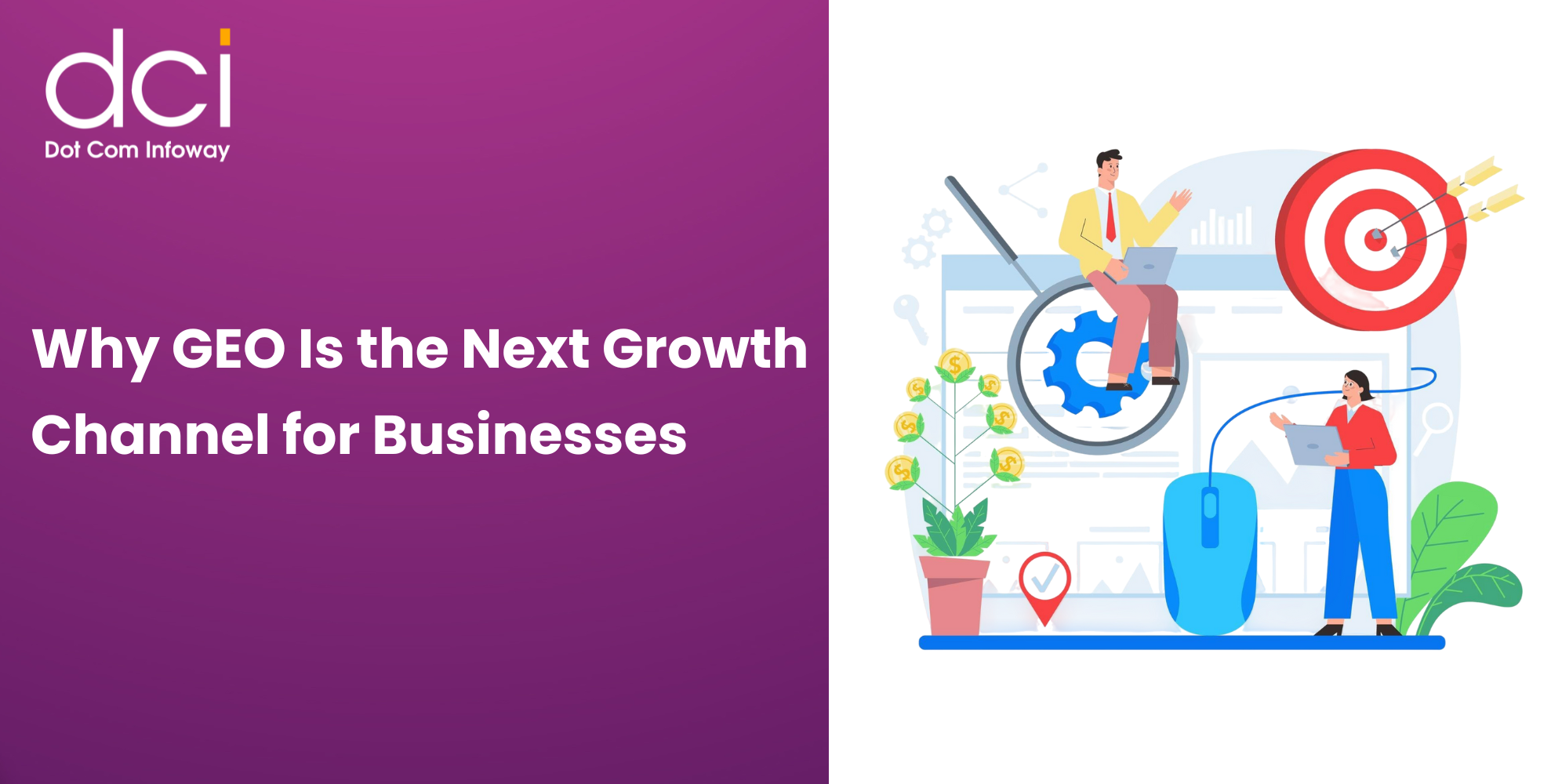
The Shift Nobody Prepared You For
Let’s start with a number that should make every digital marketer sit up straight. According to research from Gartner, AI-driven search could lead to a 50% decline in organic traffic by 2028. Half. Gone. Not because people stopped searching, but because they stopped needing to click through to find what they’re looking for.
The traditional SEO playbook: keywords, backlinks, and meta tags, was built for a world where users scrolled through ten blue links. But when someone asks ChatGPT, “What’s the best project management tool for remote teams?” they get a synthesized answer pulled from multiple sources. Your beautiful ranking position? Meaningless if the AI doesn’t cite you.
What Exactly Is Generative Engine Optimization?
Generative Engine Optimization is the practice of structuring your content, brand signals, and digital presence so that AI systems, think ChatGPT, Google’s AI Overviews, Perplexity, and Copilot, recognize, trust, and cite your brand in their generated responses.
Here’s the critical distinction that trips up most marketers: SEO determines how high your page appears in Google search results, while GEO determines how AI-generated responses represent your information. You can rank #1 on Google and still be completely absent from AI answers. In fact, research shows that fewer than 10% of sources cited in ChatGPT, Gemini, and Copilot rank in the top 10 Google organic results for the same query.
Read that again. Your competitor’s #1 Google ranking doesn’t guarantee they’ll appear in AI answers. That’s not a threat: it’s an opportunity.
The Numbers That Prove GEO Isn’t Optional
I’m not here to hype you up with vague promises. Let’s talk data.
A landmark study from Princeton University examined how different optimization techniques affect visibility in generative AI responses. Their finding? Implementing GEO strategies, particularly citing authoritative sources and adding statistics, can boost visibility by up to 40%. That’s not incremental improvement; that’s a fundamental shift in who gets seen.
“Adding citations and statistics to content are among the most effective techniques for improving visibility in generative engine responses.” : Princeton University GEO Research Study
Meanwhile, a 2025 report from Conductor revealed that 97% of digital leaders saw positive impact from AEO and GEO initiatives. But here’s the stat that should really get your attention: visitors sourced from LLM responses convert at twice the rate of traditional search traffic. These aren’t casual browsers. They’re high-intent buyers who received a direct recommendation.
And the investment trend? IDC forecasts that by 2029, LLM optimization budgets will be 5x that of traditional SEO. The early movers aren’t just experimenting: they’re reallocating serious resources.

Ready to boost your website’s rankings and online visibility?
Discover how our expert SEO services can resolve ranking issues, drive traffic, and elevate your website’s performance to the next level!
Why 2026 Is the Inflection Point
The B2B landscape has already shifted dramatically. According to industry research, 48% of B2B buyers now use AI for vendor research. That means if you’re optimizing only for Google, you’re missing nearly half your market, and arguably the highest-intent prospects.
Think about it. Someone asking ChatGPT, “Which CRM integrates best with Slack for a 50-person sales team?” isn’t casually browsing. They’re ready to buy. They want a specific answer. And if the AI cites your competitor instead of you? That deal is gone before you ever knew it existed.
The goal has fundamentally shifted from earning clicks to becoming the cited source of truth within AI-generated responses. This is the new battleground.
The 2026 Generative Engine Optimization Framework
So how do you actually win at this game? Through years of working with businesses navigating this transition, here’s what’s working right now.
Build Entity Authority
AI models don’t just recognize keywords: they recognize entities and relationships. Your brand needs to consistently appear alongside industry leaders in contexts that matter. When you’re mentioned in the same breath as established competitors across authoritative sources, AI systems start treating you as a peer rather than an unknown.
This means strategic PR, thought leadership contributions to respected publications, and ensuring your brand appears in industry discussions that AI systems crawl and learn from.
Master E-E-A-T for the AI Era
Google’s Experience, Expertise, Authoritativeness, and Trustworthiness framework matters even more for Generative Engine Optimization. Why? Because AI systems use similar signals as guardrails against hallucination. They heavily weight “trusted” datasets: authoritative publishers, consistently accurate domains, verified expert voices.
Your content needs clear author attribution, demonstrable expertise, and factual accuracy that AI can confidently reference without risking its own credibility.
Optimize for Semantic Clarity, Not Just Keywords
Here’s where traditional SEO thinking fails you. Generative engines don’t just match keywords: they interpret meaning, context, and intent. Vague, fragmented, or overly promotional content gets ignored.
Instead, focus on clear explanations with comprehensive depth. Structure your content so AI can easily extract and synthesize your insights. Define entities clearly. Provide original data when possible. Make it easy for AI to understand not just what you’re saying, but why it matters.
Create Citation-Worthy Content
The ultimate goal isn’t visibility: it’s citation. You want AI systems referencing your brand as their information source rather than pulling from forums, outdated articles, or competitors.
This requires professionally authored, factually accurate content with clear sourcing. Add statistics. Include expert quotes. Provide the depth and specificity that makes AI confident citing you.
The Strategic Imperative
Managing Generative Engine Optimization separately from SEO isn’t optional anymore: it’s essential. These channels operate on fundamentally different principles and reach distinct audiences through different mechanisms.
As Search Engine Land has noted, the businesses winning in 2026 are those treating GEO as its own discipline with dedicated strategy, resources, and measurement frameworks. They’re not abandoning SEO; they’re building a parallel growth channel that captures the audience traditional search is losing.
Your Next Move
The window for early-mover advantage in Generative Engine Optimization is closing fast. As more businesses recognize this shift, the competition for AI citations will intensify. The question isn’t whether to invest in GEO: it’s whether you’ll do it before or after your competitors start stealing your market share.
At Dot Com Infoway, we’ve been helping businesses navigate this transition with specialized LLM SEO services designed for the AI-first search landscape. Because in a world where the best answer wins, you need more than rankings. You need to be the source AI trusts.
The search landscape has changed. Has your strategy?
Must Read
Trending Blogs

![The Game Marketing Guide: Pre and Post-Launch Strategies [Infographic]](https://www.dotcominfoway.com/wp-content/uploads/2023/09/DCI-Game-Marketing-blog-1.jpg)
Latest Posts
 March 25, 2026
The Shift to AI-Native Apps: Agents, Generative AI & Real-Time Intelligence
Most businesses today are scaling operations, expanding digital channels, and generating massive amounts of data. Yet their applications remain slow, reactive, and dependent on manual inputs. This gap is exactly why AI-Native Apps are becoming essential. Instead of reacting to...
 March 23, 2026
AI Updates You Can’t Ignore: From Smart Assistants to Self-Learning Apps
If your business still relies on static apps that follow fixed rules, you’re already losing users to competitors offering smarter, more intuitive experiences. Today’s customers expect apps that understand their behavior, predict their needs, and continuously improve. This is...
 March 20, 2026
How B2B Companies Can Solve Lead Generation Challenges Using Google Ads
In today’s competitive digital landscape, many businesses struggle to generate consistent, high-quality leads. Studies show that nearly 61% of B2B marketers consider lead generation their biggest challenge. Whether you're a startup or an established brand, B2B lead generation services...
 March 19, 2026
How Marketers Use Programmatic SEO and No-Code Tools for Traffic Growth
If you’ve been investing in content but struggling to scale organic traffic, you’re not alone. Many marketers hit a ceiling-publishing blogs manually takes time, resources, and consistent effort. This is where Programmatic SEO changes the game. Instead of creating...
 March 18, 2026
Bing AI Search Update: How Websites Can Appear in AI Answer Citations
If your website ranks on Google but still doesn’t appear in AI-generated answers, you’re already losing valuable visibility. In fact, users are increasingly relying on AI-generated responses for quick, direct information. Therefore, with the rise of Bing AI Search,...
 March 16, 2026
From Automation to Agentic Commerce: The Next Step in Digital Shopping
Digital marketers and eCommerce businesses are hitting a ceiling with traditional automation. While automation has streamlined operations and reduced manual effort, it no longer delivers the level of intelligence required to compete in today’s fast-paced digital ecosystem. This is where...
 March 13, 2026
How SaaS Companies Reduce Meta Ads Cost Per Lead & Increase ROI by 3X
Running Meta Ads for SaaS products can feel like a double-edged sword. While SaaS Companies Reduce Meta Ads Cost Per Lead by leveraging smarter strategies, platforms like Facebook and Instagram still present challenges with rising CPL and fluctuating ROI. If...
 March 12, 2026
Why Is Your Website Not Appearing in AI Search Results Despite Ranking on Google?
In today’s rapidly evolving digital ecosystem, ranking on Google is no longer the only indicator of online success. Many businesses are now experiencing a visibility gap-while their websites perform well in traditional search engines, they are not being featured...
 March 11, 2026
Why LLM SEO Services and Programmatic SEO Are the Future of Search Marketing
In today’s fast-paced digital ecosystem, relying solely on traditional SEO strategies is no longer sufficient. Businesses are increasingly facing challenges like stagnant organic traffic, unpredictable algorithm updates, and declining visibility on search engines. This is where LLM SEO Services...
 March 09, 2026
From Crawl to Context: How AI Interprets Your Website Content
Many businesses today face a surprising challenge. Even though their website ranks on traditional search engines, it often fails to appear in answers generated by AI platforms like ChatGPT, Google Gemini, or Perplexity AI. This happens because AI interprets...
Get the latest insights from Dot Com Infoway straight to your inbox.