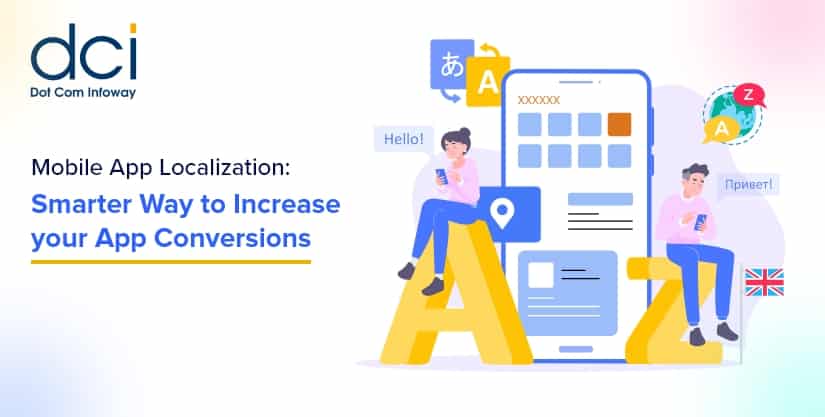
Mobile app localization is gaining massive strides in recent years. Is this really a surprise? At its core, the goal of mobile app localization services is inevitably intended to improve app visibility, increase app downloads, and, in turn, increase revenue.
Just because “localization” is attached to the term doesn’t mean that you’re limiting your scope. On the contrary, you’re actually expanding it. In this post, we’ll dive into what App localization is all about, its specific benefits, and the best strategies that will guarantee concrete, positive results.
Mobile App Localization Defined
Mobile app localization spans every strategy you adopt and effort you subsequently do to make your app more amenable and usable for its users in a specific country or region. This is done with the intent to heighten their convenience while using the app and boost their engagement.
There’s a subtlety to every language and dialect, and app localization recognizes its importance in boosting the user experience.
One of the main queries that app users have, especially if they’re using a globally-recognized app, is whether that app has a language selector or not. An app that recognizes the importance of language and culture relative to its target audience can easily stand out among a crowd of competitors.
And that pretty much readily highlights the importance of Mobile app translation and Content localization. It allows users to connect with the app more intimately, which only paves the way for it to be enjoyed and used to the fullest.
Close to half of the apps belonging to the top 10 for revenue and downloads in the App Store have users coming from non-English speaking countries.
90% of retail app users prefer to use their native language.
Apps that fail to localize can miss out on up to 15% of traffic.
Asia occupies up to 41% of total app revenue worldwide, the majority of which include countries that don’t speak English like China, Taiwan, and Japan.
Top Strategies for Continuous Success in App Localization
Any kind of digital marketing strategy has its own list of best practices. Below, we’ve highlighted app localization best practices and strategies that should, more or less, not be absent from your arsenal.
a. Pinpoint the Target Market
You can’t really miss this step since this will determine the language you’ll be adopting for your app. Conducting thorough research, especially market research, can’t be emphasized more before deciding on any country to translate for.
Are you getting significant traffic from that locale?
Do their present engagement rates show promise?
Take the time to analyze the data because there’s really no better objective reference than that.
b. Actively Review Customer Feedback
Be on the lookout specifically for feedback requesting the translation of your app. Look at both the big picture and the specifics.
By this, we mean that you should look at both the general reviews you’re getting (with regards to overall user experience while using the app) and the ones in other essential, more specialized areas like customer support.
c. Regularly Conduct Competitor Research
Look at how your competitor is improving the app that they have to offer. Obviously, you should also observe just exactly which countries they’re localizing for.
Will you be able to provide a competent and reliable translation of the app for the specific countries they’re targeting?
Not every language is worth it, nor are the difficulties to translate to each one. Again, this will require close attention to data through consistent research.
d. Focus on One Language at a Time
There’s a saying, “Don’t bite off more than you can chew.” This applies to any localization strategy you do. Acknowledge the fact that any language comes with its own complexities.
Translation takes a massive amount of time, notwithstanding the use of advanced localization tools. You need to conduct quality assurance, after all, which often entails doing multiple verifications of translation correctness and accuracy. That can be hard to do for two or more languages at once.
e. Provide Support for All Locales
This means translating for different varieties of your chosen language. In English, it’s a given that there’s American English and British English.
Once you already have a version of your app with American English, it shouldn’t be that difficult to provide versions of it in all varieties of the language available.
Doing this in other languages you choose is cost-effective since it’s easy enough to provide translations for them (meaning you won’t need to expend the same amount of resources as doing a full translation). In turn, you get to expand your local coverage in the process.
f. Find the Best Translator
App store localization and other forms of app localization require no less than the best person for the job. Translation services are aplenty online, but only a handful realize and can adhere to cultural and lingual specifics.
It goes without saying that you should only choose the one that will do justice to what your app has to offer and to its target audience.
Start Increasing your Mobile App Installs
Here we are to assist you with providing powerful result-driven strategies like mobile app localization to improve your mobile app installs & conversions. Our well-experienced Mobile Marketing team will take care of all your needs to reach your business goal.
Key Factors to Keep in Mind When Preparing for App Localization
How do localize an app that anticipates possible hurdles down the road? First and foremost, always keep these preparatory steps in mind.
a. Translation
Don’t confuse translation with localization. The translation is just a part of the whole localization process. With that in mind, translation is primarily concerned with rendering the app’s copy into the language preferred by the user.
In short, it’s focused on mainly linguistic requirements. The majority of this responsibility falls in the hands of a professional translator.
b. Internationalization
Basically, internationalization provides the solid foundations that localization will be built on. Internationalization involves creating the technical structure of the app and coming up with all the rules and methodologies you and your team will be adhering to in order to conduct proper and goal-oriented localization.
It’s safe to say that it should be an essential part of your pre-launch activities if you’re aiming to localize your content in the long run.
c. Content Localization
Localization of the actual content typically begins post-launch, though not always. It includes any translation endeavor you do on the app copy as well as the creation of features that will ensure appropriate localization.
This often means adding language keyboards, currency defaults, etc. that essentially count toward your effort to improve UI UX.
d. Implementation on the App Stores
Localization and, hence, optimization extend to the App Store. You will need to exert time and effort to make sure that your app will reflect its correct translated name, subtitles, and description, for one.
In short, you will need to be prepared to change your app’s metadata after every translation. At the end of the day, these are still vital ASO marketing elements. This also underscores why app owners work with Multilingual SEO services.
What’s good is that both Google and Apple actively support app localization through features such as auto-layout of screen layouts to account for text lengths, auto-formatting of numbers and dates based on locale, Quick Export of text strings, and built-in
Android Localization vs iOS Localization
Is there a difference between localization on Android and iOS? Yes, they are as follows:
It’s well worth doing localization for Android since it has a larger number of users than iOS, with over 3 billion active at present.
That being said, iOS users have also reached 1 billion, spanning over 170 regions and support for 40 languages.
Expect to use different localization tools for either Android or iOS apps. Tools like Agama and Lokalise are popular for Android, while for iOS, Apple tools like Apple APIs, Unicode, and Xcode 11 are being used.
Benefits of App Localization
a. Larger customer base
This is the main, most obvious benefit. Once you localize your app, you’re practically gaining access to an entire audience base that wasn’t accessible to it due to language barriers.
b. Quick entry into new markets
Being open and adaptive to app localization positions you at an advantage over others that aren’t. Given the highly competitive field that is mobile app development in general, it’s fairly obvious that you should always be looking at opportunities wherever it’s available.
c. Better user experience and engagements
Without a doubt, both are indispensable factors in growth marketing. You can’t build trust and loyalty if you aren’t connecting with your audience on a deeper, more intimate level. Only localization can unlock it.
d. Virality
This again goes back to the fact that you’re connecting with your users in their preferred native language. Anything that manages to tap into that pulse, so to speak, is more likely to be shared.
e. Diversified customers
Getting a bigger slice of the market share pie is every app marketer’s end goal. This is close to impossible to achieve nowadays without diversifying your customers through localization unless you’re a globally-recognized brand.
Conclusion
While app localization may not be considered the best strategy in mobile app marketing services yet, we can’t deny that it’s already making waves in the mobile app development industry. Ultimately, it encompasses numerous Mobile app KPIs, and that in itself is already a telling sign of its overall (still growing) importance. With the current trends considered, we can only expect it to gain more traction in the future.
The mobile industry is moving from traditional application experiences toward intelligent, adaptive platforms. Businesses today need AI-ready mobile apps that can support emerging technologies like Apple Intelligence and Android Gemini Advanced to deliver faster, smarter, and more personalized user...
An application can receive excellent ratings, positive customer feedback, and strong user satisfaction but still struggle to attract new users. Low app downloads despite good reviews is a challenge many businesses face after launching their mobile applications. While reviews...
The Apple A20 Pro chip changes what product teams can reasonably ask an iPhone app to do in real time. Built on a 2-nanometer process, the processor combines a six-core CPU, seven-core GPU, integrated Neural Accelerators, a dual 16-core...
SEO has changed significantly over the years. Search engines no longer evaluate content only based on keywords, backlinks, or publishing frequency. Today, factors such as content quality, expertise, originality, and user satisfaction play a major role in determining search...
When organic sessions decline after a broad Google update, an E-E-A-T audit checklist gives businesses a structured way to separate correlation from cause. Traffic is rarely restored by inserting more keywords, increasing word count, or changing publication dates. Sustainable...
Flutter app development productivity is becoming a strategic priority for businesses that need consistent applications across Android, iOS, web and desktop. While the headline’s 5.5% figure should be viewed as a conservative productivity benchmark rather than a verified Flutter-specific...
Search is moving beyond traditional results pages. Users now ask complete questions through ChatGPT, Perplexity, Gemini, and Google AI Overviews, expecting direct and reliable answers. This shift means brands must optimise content not only for rankings but also for...
Generating traffic is easy; attracting qualified enquiries and sales is harder. Many businesses gain visitors through social media campaigns, but low interest often results in quick exits and few conversions.Reddit offers a more focused opportunity. Users join specialised communities...
App discovery is moving beyond app-store search and paid campaigns. Users increasingly ask ChatGPT, Gemini, Perplexity, and Google’s AI experiences to compare tools, recommend apps, and narrow choices before visiting the App Store or Google Play. This makes AI...
The Google Play App Quality Rules are changing what it takes for an Android app to remain visible, compliant and competitive. According to Appfigures, Google Play's worldwide app inventory declined from approximately 3.4 million apps at the beginning of...











![The Game Marketing Guide: Pre and Post-Launch Strategies [Infographic]](https://www.dotcominfoway.com/wp-content/uploads/2023/09/DCI-Game-Marketing-blog-1.jpg)