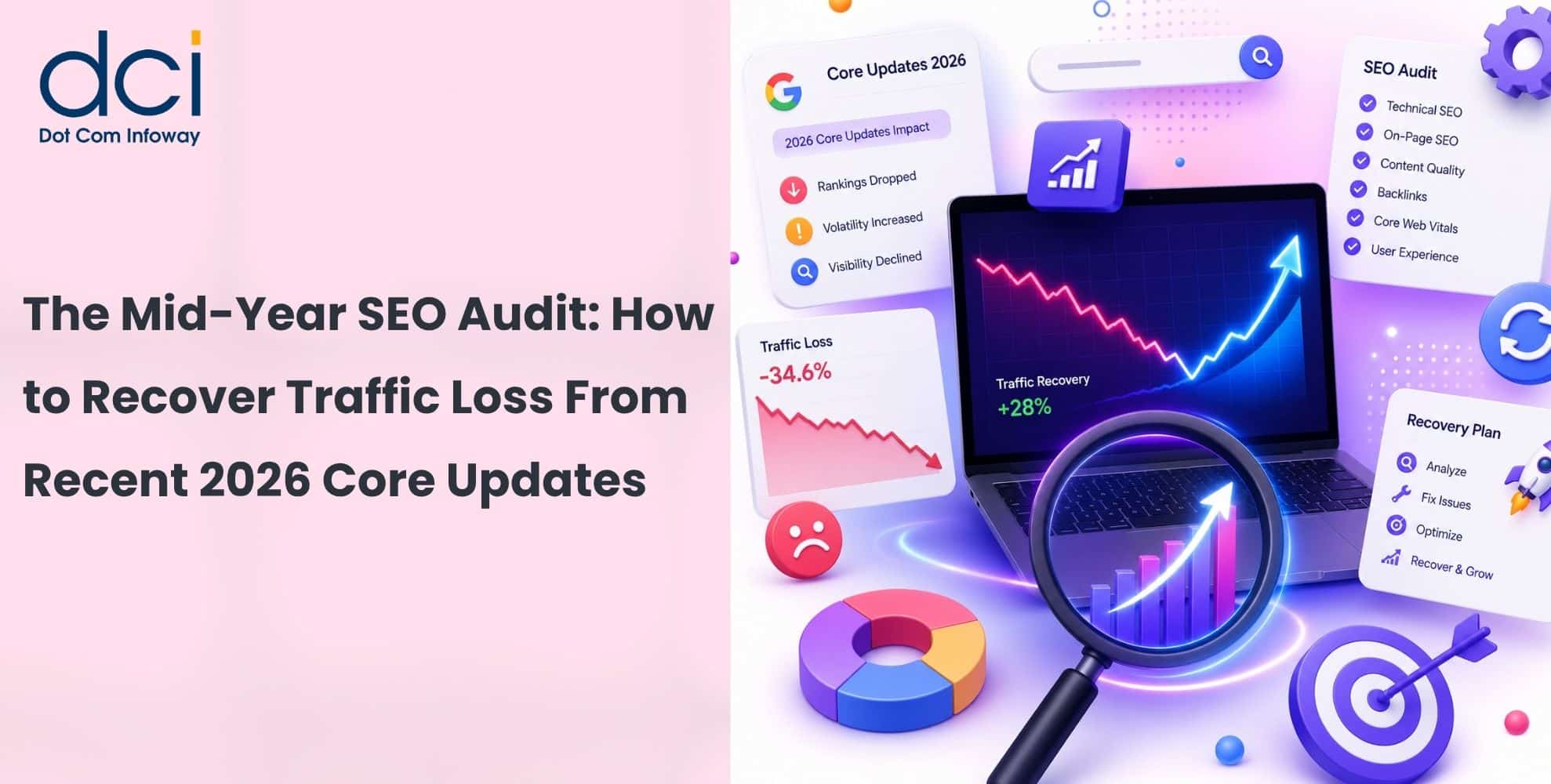
The Mid-Year SEO Audit: How to Recover Traffic Loss From Recent 2026 Core Updates

By

10 mins read

SEO in 2026 is no longer just about ranking for keywords. A mid-year SEO audit has become essential as search evolves rapidly with AI Overviews, AI Mode, changing user behaviour, and increasingly sophisticated search algorithms.

For businesses, this creates a new challenge: a website that performed well six months ago may suddenly experience lower rankings, reduced organic traffic, or fewer leads.

If your website has experienced a traffic drop following recent Google core updates, don’t immediately rewrite everything or publish hundreds of new pages. The right approach is to conduct a mid-year SEO audit, identify what changed, and create a focused recovery strategy.

The Mid-Year SEO Audit: How to Recover Traffic Loss From Recent 2026 Core Updates

What Is a Mid-Year SEO Audit?

    A mid-year SEO audit is a detailed review of your website’s performance, technical health, content, rankings, and search visibility during the first half of the year.

    The objective is to answer three important questions:

    Where did we lose traffic?
    Why did we lose it?
    What needs to be improved to recover and grow?

    A proper SEO audit in 2026 should cover technical SEO, content quality, keyword rankings, search intent, internal linking, backlinks, conversions, and visibility across AI-powered search.

    Why Has Organic Traffic Dropped in 2026?

    A decline in organic traffic doesn’t necessarily mean your website has been penalized.

    Google’s core updates can change how its systems evaluate and rank content. As a result, some pages may lose visibility while other pages gain rankings.

    Common reasons include:

    1. Search Intent Has Changed

    Your page may target the right keyword but no longer provide the type of information users are looking for.

    For example, someone searching for “mobile app development company” may expect:

    • Development services
    • Technologies
    • Portfolio
    • Case studies
    • Development process
    • Cost information
    • Industry expertise
    • Client results

    If your page only provides a basic description of your service, competitors with more comprehensive and useful information may outperform it.

    2. Competitors Have Improved Their Content

    SEO is competitive.

    Even if your website hasn’t changed, your competitors may have improved:

    • Content depth
    • User experience
    • Case studies
    • Original research
    • Expertise
    • Internal linking
    • Page structure
    • Technical performance

    A mid-year SEO audit should therefore include a competitor analysis.

    3. Content Has Become Outdated

    Technology and digital marketing change quickly.

    A blog written two or three years ago may contain outdated:

    • Statistics
    • Tools
    • Strategies
    • Screenshots
    • Examples
    • Recommendations

    Updating old content with current information can be an important part of organic traffic recovery.

    Diagnose and Fix Your SEO Performance

    Step 1: Identify Which Pages Lost Traffic

      Before changing anything, analyse your data.

      Use Google Search Console and your analytics platform to compare your website’s performance before and after the traffic decline.

      Look at:

      • Organic clicks
      • Impressions
      • Average position
      • CTR
      • Organic sessions
      • Conversions
      • Landing pages
      • Search queries

      Pay particular attention to pages where rankings moved from page one to page two or beyond.

      For example:

      The Service Page dropped from position 4 to 10, resulting in a 38% decrease in traffic. The Blog moved from position 6 to 15, with traffic declining by 52%. Similarly, the Product Page fell from position 9 to 18, leading to the highest traffic decrease of 61%.

      This allows your team to prioritize pages instead of making random SEO changes.

      Step 2: Check Technical SEO Issues

      Before rewriting content, make sure search engines can properly access and understand your website.

      Your technical SEO audit should include:

      • Indexing issues
      • Robots.txt
      • XML sitemap
      • Canonical tags
      • Redirects
      • Broken links
      • 404 errors
      • Duplicate pages
      • Mobile usability
      • Page speed
      • Core Web Vitals
      • JavaScript rendering
      • Internal linking
      • Structured data
      • HTTPS

      Technical problems can prevent even excellent content from performing well in search.

      Improve Keywords, Content, and Authority

      Step 3: Revisit Your Keyword Strategy

      Ranking for a keyword isn’t enough.

      You need to understand the search intent behind the keyword.

      For example:

      Informational
      “How does programmatic SEO work?”

      Commercial
      “Best programmatic SEO agency”

      Transactional
      “Programmatic SEO services”

      Each intent requires a different type of content.

      Instead of creating one page for every keyword variation, build content around topics and user needs.

      This is particularly important when developing a programmatic SEO strategy.

      Step 4: Improve Content Quality

      One of the biggest mistakes businesses make after a ranking decline is simply adding more words.

      Longer content doesn’t automatically mean better content.

      Instead, ask:

      • Does this page answer the user’s question?
      • Is the information accurate?
      • Is it updated?
      • Does it provide original insights?
      • Does it demonstrate real experience?
      • Does it contain useful examples?
      • Is the content easy to understand?
      • Does it answer related questions?

      The objective should be to make the page more useful than competing pages, not simply longer.


              mobile-design-300x300

              Has your website lost traffic following recent 2026 core updates?
              A comprehensive SEO audit can help identify ranking declines, technical issues, content gaps, and optimization opportunities-giving you a clear roadmap to recover visibility and strengthen organic performance.


              Step 5: Strengthen E-E-A-T

              Experience, expertise, authority and trust continue to matter when building a strong search presence.

              Businesses can strengthen these signals by adding:

              • Author profiles
              • Expert opinions
              • Client case studies
              • Original research
              • Real project examples
              • Testimonials
              • Company experience
              • Industry credentials

              For example, instead of writing:
              “We are an experienced app development company.”

              Show the experience through:
              Projects + Technologies + Results + Client Stories + Expert Insights

              This creates stronger and more credible content.

              Build Sustainable SEO Growth for Search and AI

              Step 6: Prepare Your Website for AI Overviews

              Search behaviour is changing with Google AI Overviews and AI-powered search.

              But businesses shouldn’t treat AI search as completely separate from SEO.

              Your existing SEO fundamentals still matter.

              Pages should be:

              • Crawlable
              • Indexable
              • Well structured
              • Helpful
              • Accurate
              • Original
              • Easy to understand

              Create content that directly answers important questions and then provides deeper context.

              For example:

              What Is Programmatic SEO?
              Start with a concise explanation.

              Then cover:

              • How programmatic SEO works
              • When businesses should use it
              • Common implementation mistakes
              • Quality requirements
              • Examples
              • Risks
              • KPIs

              This structure helps users find answers quickly while providing deeper information for those who want to learn more.

              Step 7: Use Programmatic SEO the Right Way

              Programmatic SEO can help businesses scale their organic search presence by creating useful pages from structured datasets and templates.

              For example:
              Service + Location
              Industry + Service
              Integration + Platform
              Product + Use Case

              However, programmatic SEO should never become a strategy of creating thousands of nearly identical pages.

              The real objective is:

              Scale useful information, not thin content.

              Every programmatic page should provide meaningful value and satisfy a distinct search intent.

              A successful programmatic SEO system should include:

              • Reliable data
              • Unique page information
              • Strong templates
              • Search-intent mapping
              • Internal linking
              • Quality control
              • Indexation management
              • Human review

                    Strengthen Internal Links and Conversions

                    Step 8: Build Strong Internal Linking

                    Internal links help users and search engines discover important pages.

                    During your SEO audit, identify:

                    • Orphan pages
                    • Pages with very few internal links
                    • Important service pages buried deep in the website
                    • Blog posts that don’t link to relevant services

                    A simple structure can be:
                    Blog → Topic → Service Page → Contact / Enquiry

                    For example:

                    A blog about mobile app development trends can link to your mobile app development service page.

                    This creates stronger topical connections across your website.

                    Step 9: Don’t Ignore Conversion Optimization

                    Recovering traffic is only part of the goal.

                    The real objective is to generate business.

                    A website receiving thousands of visitors but generating no qualified enquiries isn’t achieving its full SEO potential.

                    Review:

                    • CTA placement
                    • Contact forms
                    • Lead-generation offers
                    • Service enquiries
                    • Case studies
                    • Testimonials
                    • Trust signals
                    • Navigation
                    • Mobile experience

                    Your SEO funnel should look like:

                    Search Visibility → Organic Traffic → Engagement → Leads → Customers

                    Step 10: Measure AI Search Visibility

                    Traditional SEO reporting focuses on:

                    • Rankings
                    • Impressions
                    • Clicks
                    • CTR
                    • Traffic

                    As AI-powered search develops, businesses should also monitor how their content appears in AI-generated search experiences where reporting is available.

                    Track:

                    • AI Overview visibility
                    • AI search queries
                    • Pages appearing in AI results
                    • Branded mentions
                    • Organic traffic from search
                    • Qualified leads

                    The goal shouldn’t simply be:
                    “How many times did AI mention our brand?”

                    Instead ask:
                    “Are we visible when potential customers are asking commercially important questions?”

                    What Not to Do After a Google Core Update

                    A traffic decline can create panic, but avoid making large changes without evidence.

                    Don’t:

                    • Rewrite your entire website immediately
                    • Add keywords unnaturally
                    • Publish hundreds of low-value AI pages
                    • Delete pages without analysing their performance
                    • Buy low-quality backlinks
                    • Create duplicate content
                    • Change URLs unnecessarily
                    • Chase unverified AI SEO hacks
                    • Focus only on keyword rankings

                    Instead, use your data to identify the pages that need attention.

                    Mid-Year SEO Audit Checklist

                    Use this checklist to evaluate your website:

                    • Analyse traffic changes
                    •  Identify ranking losses
                    • Review Google Search Console data
                    • Check indexing and crawling
                    • Audit technical SEO
                    •  Review Core Web Vitals
                    •  Analyse search intent
                    • Update outdated content
                    • Improve content depth and usefulness
                    • Strengthen E-E-A-T
                    • Improve internal linking
                    •  Build topic clusters
                    •  Identify programmatic SEO opportunities
                    • Review backlinks
                    •  Improve conversion paths
                    • Monitor AI search visibility
                    • Track qualified organic leads

                    Final Thoughts

                    A Google core update shouldn’t be viewed simply as a traffic problem.

                    It is an opportunity to understand how search is changing and whether your website is still delivering the information users need.

                    The most effective SEO recovery strategy in 2026 combines:

                    Technical SEO + Quality Content + Search Intent + E-E-A-T + Programmatic SEO + AEO + Conversion Optimization

                    The goal isn’t just to recover the traffic you lost.

                    The goal is to build a website that can continue attracting qualified visitors as traditional search and AI-powered search continue to evolve.

                    SEO is no longer about creating the most content.

                    It’s about creating the most useful content-and making that value scalable.

                    Latest Posts

                    Get the latest insights from Dot Com Infoway straight to your inbox.