



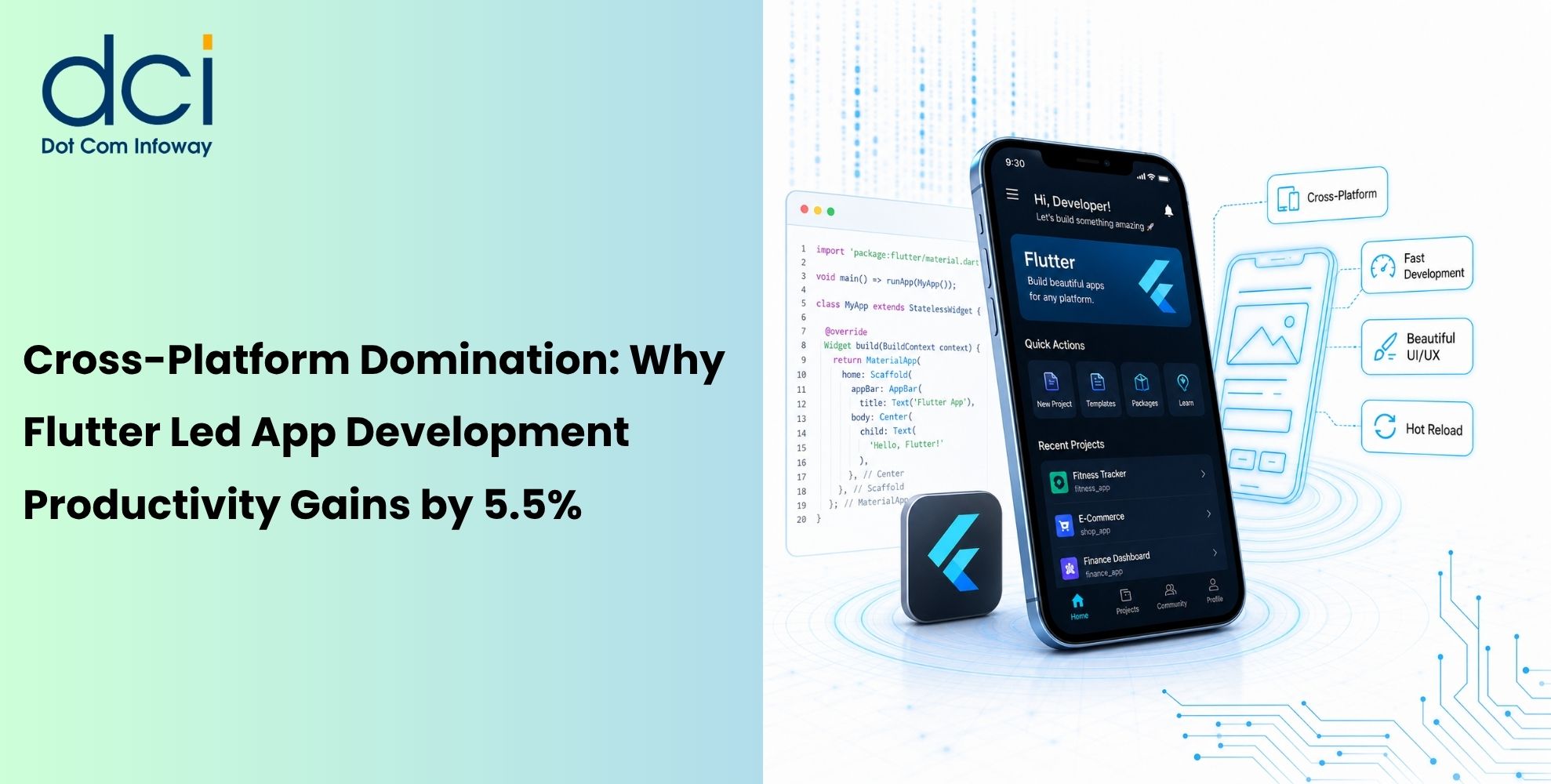
Flutter app development productivity is becoming a strategic priority for businesses that need consistent applications across Android, iOS, web and desktop. While the headline’s 5.5% figure should be viewed as a conservative productivity benchmark rather than a verified Flutter-specific average, documented Flutter projects have delivered considerably greater improvements. Through a shared codebase, reusable widgets and faster development cycles, Flutter enables teams to reduce duplicated work while retaining access to platform-specific features.
Cross-Platform Domination: Why Flutter Led App Development Productivity Gains by 5.5%
7 mins read
The Multi-Platform Development Problem
Modern businesses cannot afford to limit their digital products to one operating system. However, developing separate native applications for Android and iOS creates significant operational challenges.
The same feature may need to be written in Kotlin for Android and Swift for iOS, followed by separate testing and deployment processes. As applications grow, this duplication increases development costs, complicates maintenance and creates inconsistencies between platforms.
The problem also affects product managers, designers and quality assurance teams. Every new feature must be coordinated across multiple engineering tracks, while defects and platform differences can delay releases.
Common productivity barriers include:
- Repeated implementation of identical business logic
- Separate technical skills for Android and iOS
- Longer testing and release cycles
- Inconsistent features across platforms
- Higher long-term maintenance costs
These challenges explain why businesses are adopting shared development frameworks. Companies considering this model can explore why cross-platform development is the future of mobile apps for a broader understanding of its technical and commercial benefits.
How Flutter Improves Development Efficiency
Flutter allows developers to build applications for multiple platforms from a largely shared Dart codebase. Teams can reuse business rules, data models, interface components and application services instead of creating separate implementations for every operating system.
Its widget-based architecture enables developers to construct interfaces using reusable visual and functional components. This creates greater consistency across platforms and reduces the gap between design specifications and final implementation.
Flutter’s hot reload capability also shortens the development feedback loop. Developers can view many code changes without rebuilding the entire application, making it easier to refine layouts, animations, responsive behaviour and interface states.
Key productivity benefits include:
- One primary codebase for multiple platforms
- Reusable widgets and design components
- Faster interface iteration with hot reload
- Integrated unit, widget and integration testing
- Native API access through plugins and platform channels
Flutter does not eliminate native development completely. Applications requiring specialised hardware access or operating-system functionality may still need native modules. An experienced app development agency can evaluate which components should be shared and where native implementation is more appropriate.
Businesses comparing leading frameworks can also review Flutter vs React Native in 2026 before selecting a long-term technology stack.
Verified Results From Flutter Projects
Production case studies provide stronger evidence than general framework claims. According to the official Zoho Tables Flutter case study, the team achieved feature parity with its web application in 14% less time. It also used a 60% smaller team, reduced developer costs by 50% and decreased build times by 70%.
Zoho Tables is not a basic application. It supports complex spreadsheets and databases containing between 100 and 100,000 rows, custom scrolling and integrations with Apple Pencil and Samsung S Pen. Zoho also reported a 42% higher refresh rate compared with the other cross-platform technologies it tested.
Google Pay provides another enterprise example. Google adopted Flutter to consolidate platform-specific implementations while expanding the product into additional markets. The application scaled to more than 100 million monthly active users, showing that cross-platform development can support products operating at a global scale. Google explains the implementation in its Google Pay Flutter case study.
These cases demonstrate three major outcomes:
Faster delivery: Shared components reduce repeated engineering work.
Lower costs: Smaller teams can maintain applications across multiple platforms.
Consistent releases: Common logic helps align features, fixes and experiences.

Want to improve cross-platform app development productivity with Flutter?
Work with an experienced app development agency to build scalable, high-performance apps faster across iOS and Android. Start your Flutter project today.
Converting Framework Speed Into Business Value
Technology alone cannot guarantee higher productivity. Businesses must combine Flutter with modular architecture, automated testing, continuous integration and performance monitoring.
Implementation should begin with a detailed product assessment covering target platforms, integrations, offline requirements, security controls and performance-sensitive workflows. This analysis reveals which parts of the application can be shared and which require native development.
Teams should then separate presentation, business logic and data access into maintainable modules. A reusable design system can further prevent developers from creating inconsistent versions of the same interface component.
Automated pipelines should run code analysis, tests and platform builds whenever shared logic changes. This protects quality while allowing teams to release updates frequently.
With these practices in place, Flutter app development productivity becomes more than a measure of coding speed. It can reduce time to market, improve release predictability and direct engineering resources toward customer value instead of duplicated platform work.
When Should Businesses Choose Flutter?
Flutter is particularly suitable for startups launching minimum viable products, enterprises modernising customer applications and organisations requiring consistent experiences across several platforms.
Before selecting Flutter, businesses should evaluate:
- The platforms required over the next several years
- Plugin availability for essential integrations
- Performance demands of critical user journeys
- Existing engineering skills and resources
- Long-term testing and maintenance costs
Flutter may be less suitable when an application depends heavily on one operating system, requires highly specialised native rendering or relies on unsupported device capabilities. Working with a qualified app development agency can help businesses determine whether Flutter, native development or a hybrid architecture offers the best lifecycle value.
Conclusion
Even a 5.5% productivity improvement can deliver meaningful savings across repeated development cycles. However, verified Flutter projects suggest that the gains can be much greater when organisations reduce code duplication, streamline testing and create shared delivery workflows.
Flutter’s advantage is not simply its ability to produce applications for multiple platforms. Its real value comes from reducing the operational complexity of maintaining those products.
Businesses should view Flutter app development productivity as the result of a complete development strategy rather than an automatic framework guarantee. With the right architecture, testing process and technical expertise, Flutter can accelerate releases, lower development costs and deliver consistent digital experiences across platforms.
Must Read


Trending Blogs

![The Game Marketing Guide: Pre and Post-Launch Strategies [Infographic]](https://www.dotcominfoway.com/wp-content/uploads/2023/09/DCI-Game-Marketing-blog-1.jpg)
Latest Posts
August 27, 2026
Cross-Platform Domination: Why Flutter Led App Development Productivity Gains by 5.5%
Flutter app development productivity is becoming a strategic priority for businesses that need consistent applications across Android, iOS, web and desktop. While the headline’s 5.5% figure should be viewed as a conservative productivity benchmark rather than a verified Flutter-specific...
 August 24, 2026
GEO Frameworks: How to Rank on AI Search as Zero-Click Results Hit 69%
Search is moving beyond traditional results pages. Users now ask complete questions through ChatGPT, Perplexity, Gemini, and Google AI Overviews, expecting direct and reliable answers. This shift means brands must optimise content not only for rankings but also for...
 August 21, 2026
From Low-Quality Traffic to High-Intent Leads: How Reddit Communities Are Driving Better Business Conversions
Generating traffic is easy; attracting qualified enquiries and sales is harder. Many businesses gain visitors through social media campaigns, but low interest often results in quick exits and few conversions.Reddit offers a more focused opportunity. Users join specialised communities...
 August 19, 2026
How AI Search Is Becoming the Next Major App Acquisition Channel
App discovery is moving beyond app-store search and paid campaigns. Users increasingly ask ChatGPT, Gemini, Perplexity, and Google’s AI experiences to compare tools, recommend apps, and narrow choices before visiting the App Store or Google Play. This makes AI...
 August 17, 2026
Why Google Dropped Millions of Apps: The New App Store Quality Rules Explained
The Google Play App Quality Rules are changing what it takes for an Android app to remain visible, compliant and competitive. According to Appfigures, Google Play's worldwide app inventory declined from approximately 3.4 million apps at the beginning of...
 August 14, 2026
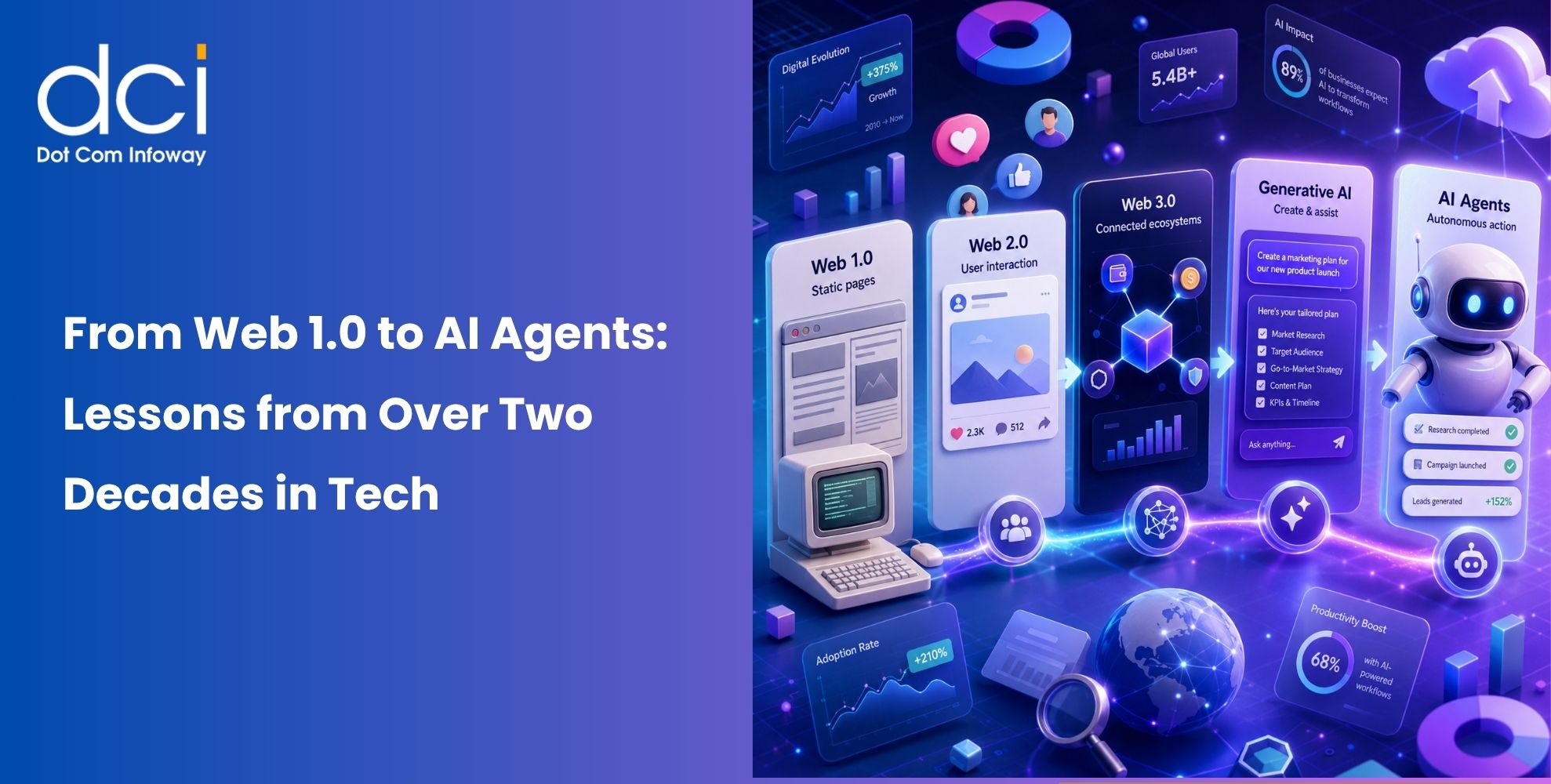
From Web 1.0 to AI Agents: Lessons from Over Two Decades in Tech
In 2000, a business website was often a digital brochure: a few HTML pages, contact details, and a basic form. Today, software can interpret intent, generate content, call APIs, coordinate tasks, and act with limited human intervention. Technology Evolution...
 August 12, 2026
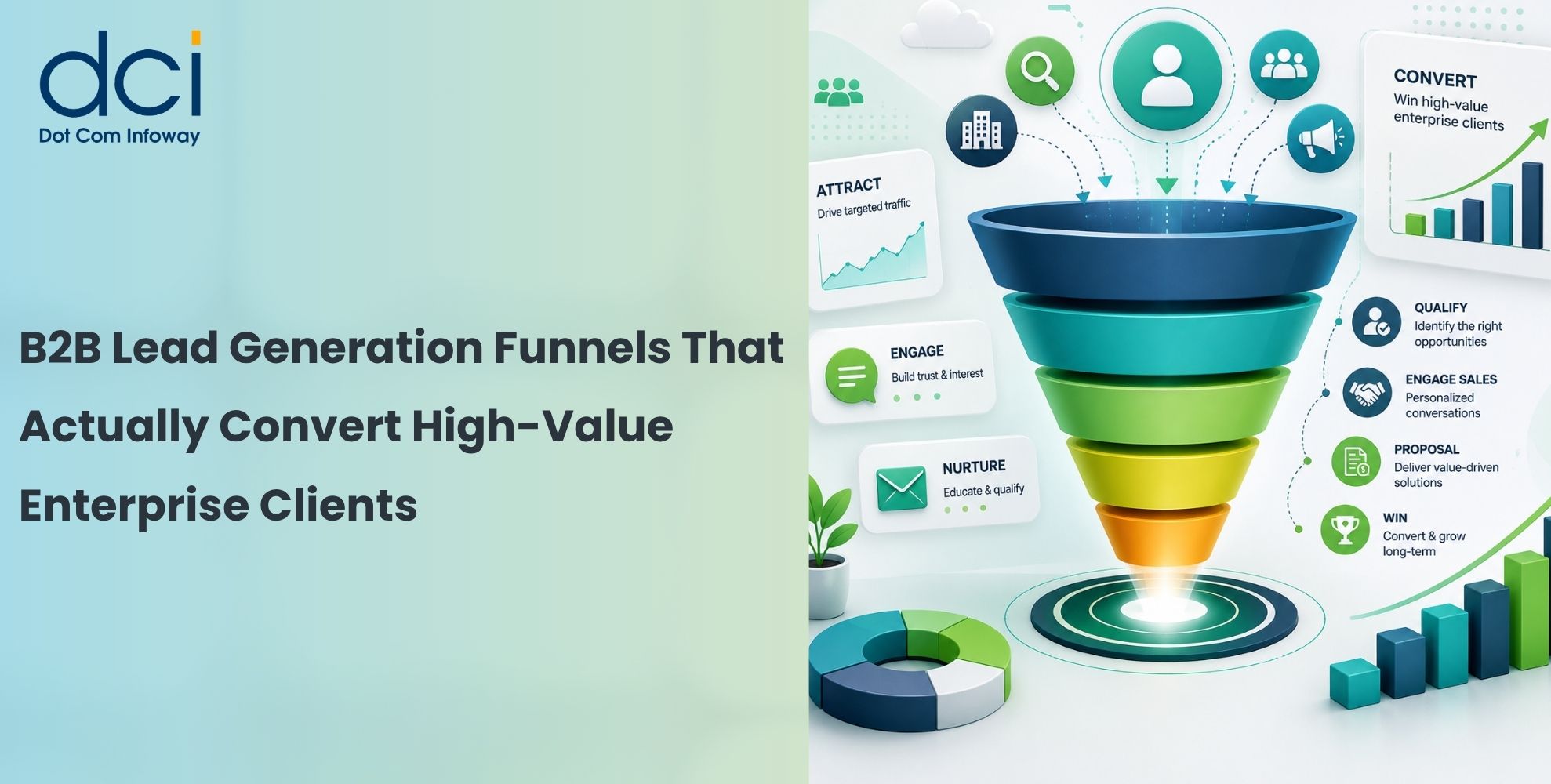
B2B Lead Generation Funnels That Actually Convert High-Value Enterprise Clients
Generating B2B leads is easy. Generating qualified leads that can become high-value enterprise clients is harder.Enterprise buying journeys often involve multiple stakeholders, approvals, vendor comparisons, and months of research. An effective B2B lead generation funnel must attract the right...
 August 10, 2026
AI Integration Checklist: How to Securely Connect LLMs to Your Legacy Enterprise Software
Legacy enterprise software continues to support critical business operations across banking, healthcare, manufacturing, insurance, logistics, retail, and other industries. These systems often contain years of business logic, customer data, workflows, and operational knowledge. However, many legacy applications were built...
 August 06, 2026
7 Schema Markup Advanced Techniques to Win Voice Search and AI Snippets
Search is changing rapidly. People are no longer relying only on traditional Google searches. They are asking conversational questions through voice assistants and using AI-powered search experiences such as Google AI Overviews, making schema markup techniques increasingly important for...
 August 04, 2026
The Mid-Year SEO Audit: How to Recover Traffic Loss From Recent 2026 Core Updates
SEO in 2026 is no longer just about ranking for keywords. A mid-year SEO audit has become essential as search evolves rapidly with AI Overviews, AI Mode, changing user behaviour, and increasingly sophisticated search algorithms. For businesses, this creates a...
Get the latest insights from Dot Com Infoway straight to your inbox.