



Study: Apple Apps Crash More Than Android Apps
2 mins read
According to a recent report released by the mobile OS crash analysis firm Crittercism, iOS apps tend to crash more often than Android apps.
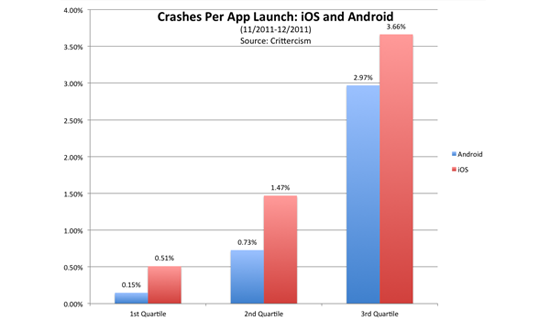
The report was based on the analysis of more than 214 million different app launches during the months of November and December 2011 and it shows that iOS apps crashed 162 million times and Android apps, on the other hand, crashed only 52 million times. This implies that iOS apps crashed three times as much as the Android apps.
Crittercism commented that the crash of iOS apps is mainly due to the upgradation of Apple’s operating system iOS 5.0 to a newer version iOS 5.0.1. It claimed that there may be some compatibility issues that might have occurred with the upgradation.
Crittercism analyzed apps under three categories. Under the ‘first quartile of apps’, Android users had 0.15% of app crashes as compared to Apple’s 0.51%. Under the ‘second quartile of apps’, Android’s crashes were 0.73% and Apple’s crashes were 1.47%. Under the ‘third quartile of apps’, Android app crashes extended to 2.97% whereas Apple’s were 3.66%
Dot Com Infoway is an Android application development company with many popular apps to its credit. To know more about our services, visit our Android app development page and Mobile app development page.



![The Game Marketing Guide: Pre and Post-Launch Strategies [Infographic]](https://www.dotcominfoway.com/wp-content/uploads/2023/09/DCI-Game-Marketing-blog-1.jpg)
Latest Posts
 September 28, 2026
From Apps to AI Agents: How Agentic AI Is Redefining the Mobile Experience in 2027
For years, the mobile experience has followed a familiar pattern: users open an app, navigate through menus, enter information, select an action, and wait for a result. Agentic AI is beginning to change that model. Instead of requiring users to manually...
 September 24, 2026
SEO AEO Grader ToolAre Search Engines Hiding Your Content? Find Out with Our Free SEO & AEO Audit Tool
You publish high-quality content, optimize your website, and follow SEO best practices, but your pages still struggle to appear on search engines. You are not alone. Many businesses face the same challenge where their content exists online but fails...
 September 23, 2026
Your Website Works Today but Cannot Scale Tomorrow: Signs of an Outdated Architecture
A website can appear successful on the surface while quietly developing problems underneath. It may load correctly, handle current visitors, and support existing business operations, but that does not always mean it has a scalable website architecture prepared for...
 September 21, 2026
From Creation to Conversion: The Business Case for Replacing Traditional B2B Video Agencies with Hybrid AI Workflows
Video has become one of the most important communication tools for modern B2B businesses. Companies use videos to explain complex products, showcase solutions, educate customers, support sales teams, and build stronger brand connections. However, as businesses demand more content...
 September 18, 2026
The AI Acceleration: How FlutterFlow and Multiplatform Frameworks Shrink Dev Timelines by 40%
The mobile app development landscape is changing faster than ever. Businesses today need powerful digital products delivered quickly, but traditional development processes often involve long coding cycles, separate teams for different platforms, and higher development costs. The rise of AI-powered...
 September 16, 2026
Is Your Mobile App Ready for Apple Intelligence and Android Gemini Advanced Integration?
The mobile industry is moving from traditional application experiences toward intelligent, adaptive platforms. Businesses today need AI-ready mobile apps that can support emerging technologies like Apple Intelligence and Android Gemini Advanced to deliver faster, smarter, and more personalized user...
 September 14, 2026
Low App Downloads Despite Good Reviews: Development and ASO Issues to Fix
An application can receive excellent ratings, positive customer feedback, and strong user satisfaction but still struggle to attract new users. Low app downloads despite good reviews is a challenge many businesses face after launching their mobile applications. While reviews...
 September 10, 2026
How Apple’s New A20 Pro Chip Reshapes Mobile App Performance Capabilities
The Apple A20 Pro chip changes what product teams can reasonably ask an iPhone app to do in real time. Built on a 2-nanometer process, the processor combines a six-core CPU, seven-core GPU, integrated Neural Accelerators, a dual 16-core...
 September 09, 2026
Decoding Google’s SpamBrain AI: How to Bulletproof Your Content Strategy
SEO has changed significantly over the years. Search engines no longer evaluate content only based on keywords, backlinks, or publishing frequency. Today, factors such as content quality, expertise, originality, and user satisfaction play a major role in determining search...
 September 07, 2026
The E-E-A-T Audit Checklist: Reviving Traffic After a Core Algorithmic Hit
When organic sessions decline after a broad Google update, an E-E-A-T audit checklist gives businesses a structured way to separate correlation from cause. Traffic is rarely restored by inserting more keywords, increasing word count, or changing publication dates. Sustainable...
Get the latest insights from Dot Com Infoway straight to your inbox.