In today’s competitive app market, getting users to download your app is only half the battle keeping them is the real challenge. With millions of apps competing for attention, users are quick to uninstall anything that fails to deliver value, performance, or trust. This infographic explores the most common reasons users remove apps, backed by recent statistics, and highlights key trends in uninstall behavior across categories. It also outlines practical strategies brands can implement to reduce churn, boost retention, and transform one-time downloads into long-term, loyal users.
Solve the Mystery Once and For All!
Talk to our marketing experts to learn why your users are deleting your app from their phones.
32% of users uninstall apps that don’t deliver enough value or meet their expectations.
PERFORMANCE
App uses too much CPU or device resources
Drains battery faster than expected
Stores/cache data excessively
Takes too long to load or respond
53% of users abandon or uninstall apps due to slow loading and poor performance.
TRUST & PRIVACY
App flagged as malware or unwanted by other software
Works only on fast networks (poor offline/low-signal experience)
Requires too many permissions (especially on social networks)
Sends invites or shares without the user’s knowledge
Developer remains unresponsive when a user reports a problem
43% of users uninstall an app if it requires too many permissions or access to personal information.
STATISTICS (2023-2025)
More than 1 in every 2 apps are uninstalled within 30 days of download.
On Android, the average uninstall rate within 30 days in 2024 was ~ 46.1%.
On average across platforms: Day 1 retention ~21% (Android) & ~24% (iOS); by Day 30 as low as ~2–4%.
32% of users say freeing up storage is a reason for deleting apps.
30% of users uninstall apps because of too many in-app ads.
17% of users decide to uninstall after the first use.
Other key reasons: poor onboarding/sign-in experience, excessive permissions, large app size, slow performance.
APP RETENTION RATE BY CATEGORY (Recent Trends)
For many apps: retention after 30 days is extremely low (often <5%).
In 2024, categories with highest uninstall rates: Dating & Gaming.
APP DESIGN STRATEGIES TO AVOID UNINSTALLATIONS
Make sure your app delivers value quickly users decide fast.
Ensure onboarding is simple, intuitive and shows the benefit immediately.
Optimize for performance: fast load times, minimal crashes, efficient resource usage.
Request only essential permissions, and clearly explain why you need them.
Keep the app size/update size manageable, and support offline or low-network mode where relevant.
Be mindful of ads & notifications: they should add value, not annoy.
Stay responsive to user feedback, bugs and support queries — trust matters.
Localize your app for multiple languages/regions if you target global audiences.
Conclusion
High uninstall rates show that users now prioritize value, performance, and trust above all else. Apps that fail to meet expectations or deliver smooth experiences are quickly replaced by better alternatives. To stay competitive, brands must focus on continuous optimization, user engagement, and strategic promotion. This is where Dot Com Infoway’s Mobile App Marketing Services help drive sustainable growth by reducing churn and improving retention. With the right strategy, your app can evolve from being just downloaded to becoming a daily essential.
Reactivating inactive app users is an effective way to improve engagement without increasing your user acquisition budget. While advertising, influencer marketing, and App Store Optimization can help attract new users, some may stop using your app over time.
Reactivating inactive...
Getting lots of downloads is a great thing, but if you aren’t generating revenue, you could be missing valuable business opportunities. Many businesses invest significant time and money in developing and marketing their apps, yet struggle to turn downloads...
Imagine that a business wants to establish its online presence. It can choose a website builder to launch a website quickly using ready-made templates, or invest in custom web development to create a website tailored to its specific needs....
Let’s imagine that there is a customer who shops online. He browses the online store’s catalog, finds the item that he wants to purchase, and adds it to his cart. However, he does not complete the order, resulting in...
Every business wants to turn its ideas into successful applications. However, many organizations invest in development and distribution without knowing whether their products will attract customers or generate revenue. As a result, they waste resources creating applications that may...
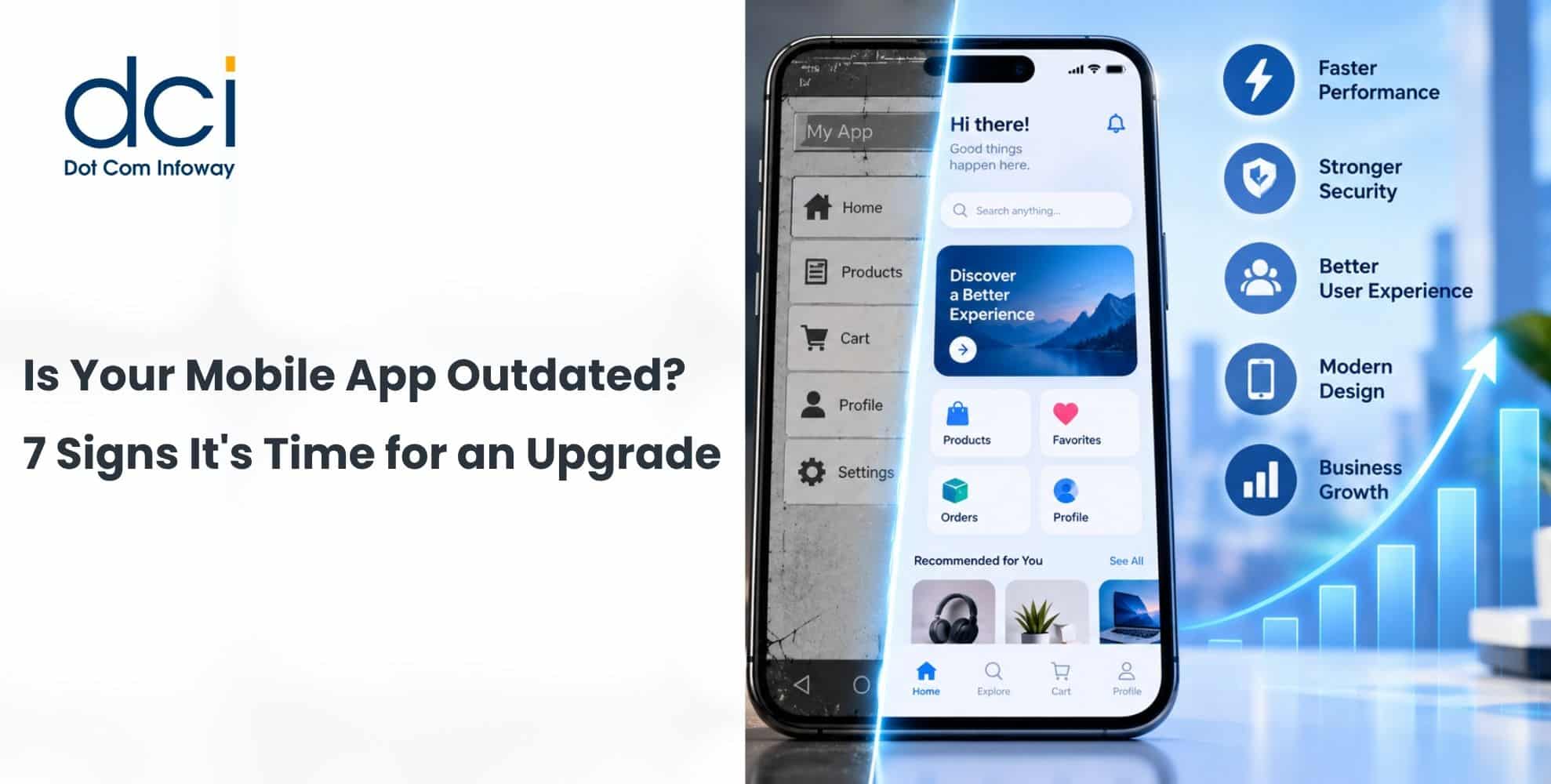
Your app launched to great reviews, but a few years on, downloads have flattened and complaints are creeping in. If your business needs a mobile app upgrade, it may be time to consider modernizing it. Devices, operating systems, and...
For years, the mobile experience has followed a familiar pattern: users open an app, navigate through menus, enter information, select an action, and wait for a result.
Agentic AI is beginning to change that model.
Instead of requiring users to manually...
You publish high-quality content, optimize your website, and follow SEO best practices, but your pages still struggle to appear on search engines. You are not alone. Many businesses face the same challenge where their content exists online but fails...
A website can appear successful on the surface while quietly developing problems underneath. It may load correctly, handle current visitors, and support existing business operations, but that does not always mean it has a scalable website architecture prepared for...
Video has become one of the most important communication tools for modern B2B businesses. Companies use videos to explain complex products, showcase solutions, educate customers, support sales teams, and build stronger brand connections. However, as businesses demand more content...









![The Game Marketing Guide: Pre and Post-Launch Strategies [Infographic]](https://www.dotcominfoway.com/wp-content/uploads/2023/09/DCI-Game-Marketing-blog-1.jpg)