Why Standard LinkedIn Posts Struggle to Sustain Engagement
A standard LinkedIn post depends heavily on initial engagement. When likes, comments and shares slow down, the post gradually disappears from users’ feeds. Even high-quality content may therefore reach only a portion of a company’s followers.
Newsletters operate differently. Users actively subscribe to receive future editions, creating a permission-based audience within LinkedIn. Subscribers can receive notifications and email alerts when a new edition is published, increasing the probability of repeated content exposure.
This recurring distribution model is particularly valuable for companies using LinkedIn lead generation to reach founders, executives, procurement teams and other decision-makers. Instead of depending on a single post to create a conversion, newsletters support multiple interactions throughout a longer B2B buying cycle.
Why LinkedIn Newsletters Can Generate Higher Engagement
LinkedIn newsletters combine the professional reach of social media with the retention benefits of email publishing. Their engagement advantage comes from four key factors:
- Subscribers receive recurring publication notifications.
- Long-form editions provide more space for useful insights.
- Previous editions remain available as a searchable content library.
- Consistent publishing builds familiarity and subject-matter authority.
The value of authoritative content is supported by B2B research. The 2024 Edelman–LinkedIn B2B Thought Leadership Impact Report surveyed nearly 3,500 management-level professionals across seven markets. It found that strong thought leadership can prompt decision-makers to reconsider business challenges and research solutions they had not previously considered.
LinkedIn newsletter adoption also reflects demand for recurring professional content. LinkedIn reported in 2023 that approximately 28 million members were subscribed to at least one newsletter.
These figures explain why newsletters can outperform standard posts: the audience is not merely scrolling past the content. Subscribers have intentionally requested future insights on a particular subject.
Turning Irregular Posts Into a Consistent Content Series
The most common LinkedIn publishing weakness is fragmentation. A company may post about industry news one day, a service promotion the next day and an unrelated event later in the week. Although each post may be relevant, the audience receives no consistent reason to return.
A newsletter resolves this by organising expertise around a repeatable theme. For example:
- A cybersecurity company can publish a monthly threat-intelligence briefing.
- A SaaS company can share product adoption and automation insights.
- A marketing agency can analyse search, social media and AI visibility trends.
- A consulting firm can publish regulatory and market updates for executives.
This structure also strengthens a broader content marketing programme because each newsletter can be repurposed into standard LinkedIn posts, short videos, carousels, email campaigns and website articles.
Instead of constantly creating disconnected material, the business develops one authoritative content asset and distributes it across multiple channels.
A Practical Newsletter Publishing Framework
A high-performing newsletter should answer a clearly defined audience need rather than promote the company in every edition.
1. Select a focused subject
Choose a topic that connects audience challenges with the organisation’s expertise. A narrow focus generally attracts fewer but more commercially relevant subscribers.
2. Establish a consistent schedule
Weekly, fortnightly or monthly publishing can work effectively. The best frequency is one the team can maintain without reducing content quality.
3. Use evidence and practical examples
Each edition should include original observations, industry statistics, customer situations or actionable recommendations. Generic summaries are less likely to generate comments, shares or AI-search citations.
4. Create a strong opening
The first paragraph should immediately explain the issue, its business impact and what the reader will learn. Avoid lengthy company introductions.
5. End with one relevant action
The call to action may invite readers to comment, subscribe, read a related article, download a resource or contact the company. Multiple competing actions can reduce response rates.
Example: Newsletter Performance Versus Standard Posts
Consider a B2B software company publishing eight short promotional posts each month. Each post receives initial impressions, but engagement declines within a few days and the posts generate limited website traffic.
The company replaces part of this activity with a fortnightly newsletter focused on workflow automation. Each edition includes an operational challenge, supporting data, an implementation example and a link to a detailed resource.
Over several months, a LinkedIn Newsletter Strategy builds a subscriber base while standard posts are used to promote individual editions. Engagement improves because readers receive consistent value and encounter the company repeatedly. Website visitors also become better informed before requesting a demonstration.
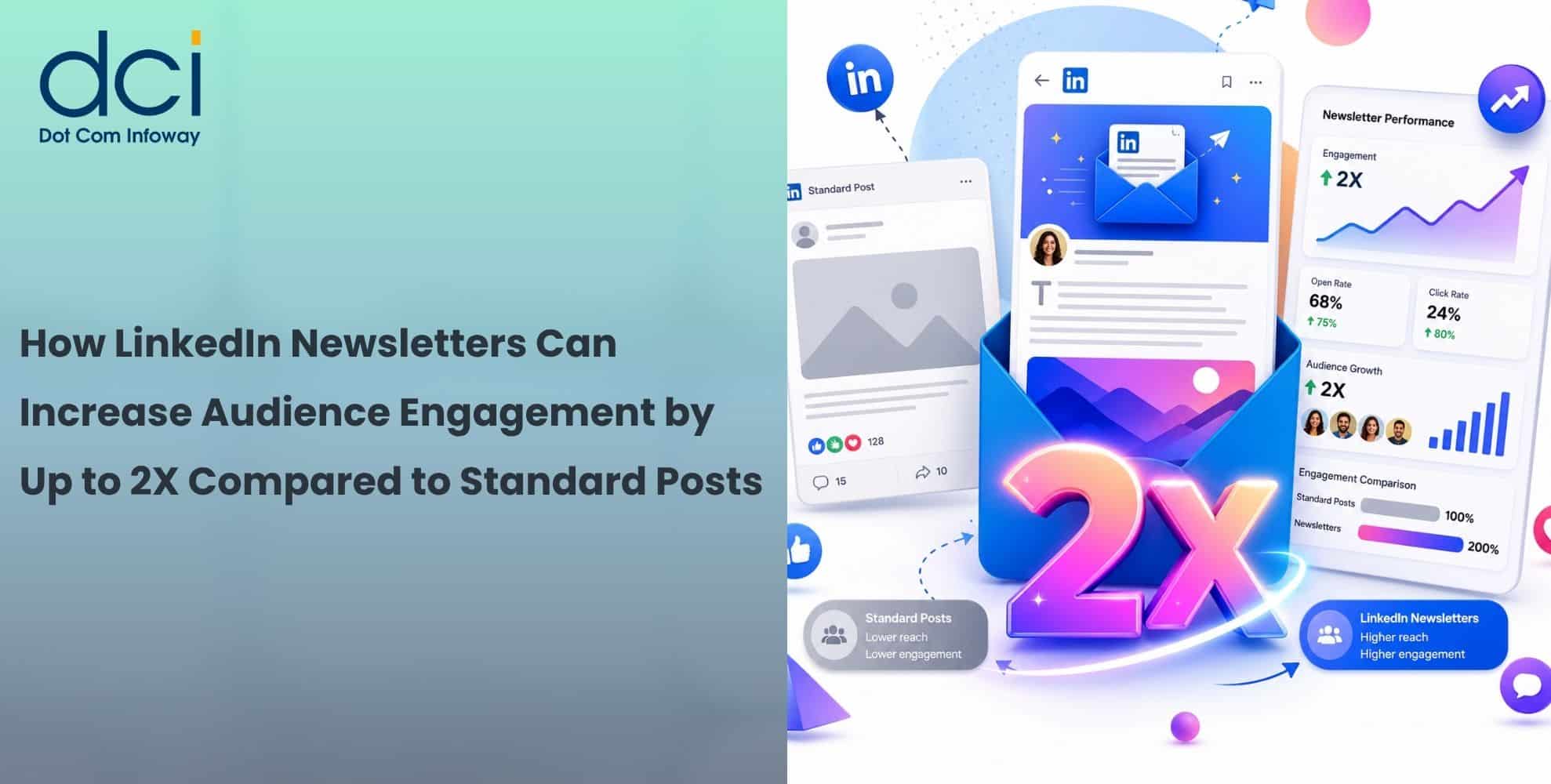
This is how newsletters can produce engagement gains approaching 2X: not because the format automatically guarantees stronger results, but because it combines subscriptions, notifications, long-form value and consistent publication.




![The Game Marketing Guide: Pre and Post-Launch Strategies [Infographic]](https://www.dotcominfoway.com/wp-content/uploads/2023/09/DCI-Game-Marketing-blog-1.jpg)