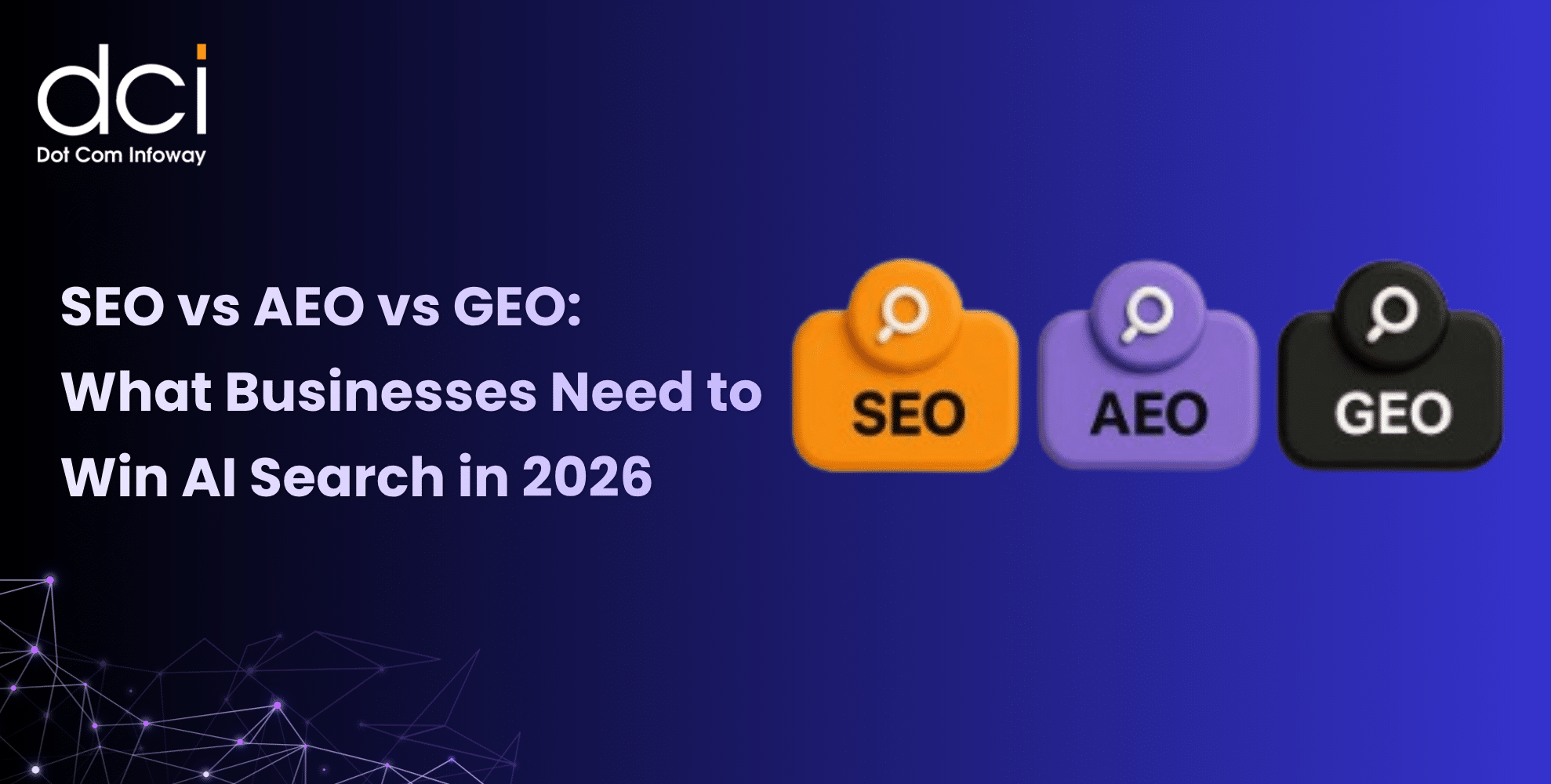
SEO vs AEO vs GEO: What Businesses Need to Win AI Search in 2026

By

9 mins read

The way people discover information online is changing rapidly. Instead of relying solely on Google search results, users are increasingly turning to AI-powered platforms such as ChatGPT, Gemini, Perplexity, and Google AI Overviews to find answers, compare solutions, and make purchasing decisions. As this shift accelerates, understanding SEO vs AEO vs GEO has become critical for businesses that want to maintain visibility and attract qualified traffic in 2026.

For years, ranking on Google’s first page was the primary goal of digital marketing. Today, however, being visible in AI-generated responses is equally important. According to Gartner, traditional search engine volume is projected to decline by 25% by 2026 as users increasingly adopt AI assistants and generative search experiences. At the same time, several industry reports show that referral traffic from AI platforms has grown significantly over the past year, creating a new channel for customer acquisition.

Businesses that adapt to this evolution will gain a competitive advantage, while those relying solely on traditional SEO strategies risk losing visibility in the places where users are now seeking information.

SEO vs AEO vs GEO: What Businesses Need to Win AI Search in 2026

Search Is No Longer Just About Rankings

    A few years ago, a customer searching for a service would enter a keyword into Google, review multiple websites, and gradually narrow down their options.

    Today, the experience is different.

    A user might ask:
    “Which digital marketing strategy delivers the best ROI for SaaS companies?”

    Instead of displaying ten blue links, AI platforms generate a detailed response containing recommendations, explanations, comparisons, and source references.

    This creates a major shift in how businesses earn visibility. Success is no longer measured solely by rankings. Brands must also become trusted sources that AI systems can understand, cite, and recommend.

    Recent studies suggest that nearly 60% of searches now end without a click because users receive answers directly within search results. With AI-generated answers becoming more prominent, businesses need a strategy that extends beyond traditional optimization.

    Why SEO Still Matters

    Search Engine Optimization remains the foundation of online visibility.

    Strong SEO ensures that search engines can crawl, understand, and rank your website effectively. Technical performance, content quality, authority, and backlinks continue to influence how websites are evaluated.

    Businesses investing in AI-Powered On-Page Optimization are already seeing improvements in content relevance, user engagement, and organic visibility.

    Key elements of effective SEO include:

    • High-quality content aligned with user intent
    • Technical website optimization
    • Internal linking structure
    • Page speed and user experience
    • Authority-building backlinks

    While these fundamentals remain essential, SEO alone is no longer enough to dominate search visibility.

    A website may rank highly for a keyword but still fail to appear in AI-generated answers. This is where AEO and GEO come into play.

      Understanding Answer Engine Optimization (AEO)

        Answer Engine Optimization focuses on helping content become the preferred answer for AI assistants and voice search platforms.

        When users ask direct questions, AI systems look for content that provides concise, trustworthy, and well-structured responses.

        For example, if someone asks:

        “What is Answer Engine Optimization?”

        AI platforms typically prioritize content that includes:

        • Direct definitions
        • Structured explanations
        • FAQ sections
        • Clear heading hierarchy
        • Schema markup

        Businesses implementing recommendations from an AEO Guide often improve their chances of appearing in AI-generated answers because their content becomes easier for machines to understand and extract.

        Similarly, understanding AEO Services Explained can help organizations align their content with how modern answer engines process information.

        The goal of AEO is simple: make your content the most reliable answer available.

        The Rise of Generative Engine Optimization (GEO)

          Generative Engine Optimization represents the next phase of digital visibility.

          Unlike SEO, which focuses on rankings, or AEO, which focuses on direct answers, GEO focuses on increasing the likelihood that AI systems cite and recommend your content when generating responses.

          Imagine a user asking:

          “Which digital marketing agency specializes in mobile app marketing?”

          An AI platform may analyze dozens of sources before generating a recommendation.

          The businesses that appear are often those that demonstrate:

          Strong topical authority
          Credible expertise
          Original insights
          Reliable data
          Consistent online mentions

          This is why many organizations are exploring How GEO Is Redefining SEO and developing a dedicated GEO Strategy for 2026.

          Research from Princeton University found that content enriched with expert insights, statistics, and authoritative references significantly improves the likelihood of being cited within AI-generated responses.

          In practical terms, GEO helps businesses become trusted sources rather than simply searchable websites.


            mobile-design-300x300

            Is SEO alone enough to win AI search in 2026?
            Not anymore. Businesses need a combination of SEO, AEO, and GEO to stay visible across traditional search engines, AI-powered answer platforms, and generative search experiences. Adapting to all three helps ensure your content is found, trusted, and surfaced wherever users search.


            What AI Platforms Prefer in 2026

            As the debate around SEO vs AEO vs GEO continues to evolve, one thing is clear: AI platforms are becoming more selective about the content they surface. Although every AI platform uses different algorithms, common patterns are emerging across ChatGPT, Gemini, Perplexity, and Google AI Overviews.

            AI systems consistently favor content that demonstrates expertise, authority, and trustworthiness, making high-quality, well-structured content essential for visibility in AI-driven search results.

            The types of content most likely to earn citations include:

            Original research and statistics
            Expert commentary
            Industry-specific insights
            Comprehensive topic coverage
            Clear content structure
            Supporting evidence and examples

            For example, a generic article discussing AI marketing trends may struggle to gain visibility.

            An article featuring proprietary survey data, industry benchmarks, and real-world case studies is significantly more likely to be cited.

            This is one reason why thought leadership content continues to outperform generic content in AI-powered search environments.

              A Real-World Example

              Consider two software companies targeting the same topic.

              Company A publishes a standard blog summarizing information available on hundreds of other websites.

              Company B publishes:

              • Original customer survey results
              • Product comparison research
              • Industry benchmark data
              • Expert analysis
              • Detailed implementation examples

              Both companies may rank on Google.

              However, when AI systems generate answers about that topic, Company B has a much greater chance of being cited because it contributes unique value.

              This illustrates one of the biggest changes in modern search.

              Visibility is no longer determined solely by keywords.

              Authority, originality, and credibility now play a larger role than ever before.

              Building a Future-Proof Search Strategy

              The businesses that succeed in AI search are not choosing between SEO, AEO, and GEO.

              Instead, they combine all three approaches.

              An effective strategy includes:

              • Building strong SEO foundations
              • Creating content optimized for answer extraction
              • Publishing original research and insights
              • Strengthening topical authority
              • Improving entity recognition across the web
              • Monitoring AI citation opportunities

              Organizations looking to improve AI visibility should also understand AI SEO Explained and stay informed about AI Mode SEO Explained , as these emerging frameworks influence how AI platforms evaluate and recommend content.

              Additionally, businesses can assess their readiness using DCI’s SEO and AEO Grader Tool, which helps identify opportunities to improve both search visibility and AI discoverability.

              Why Early Adoption Matters

              Many businesses are still focused exclusively on traditional search rankings.

              This creates a significant opportunity for organizations willing to embrace AI search optimization today.

              Just as early adopters of SEO gained long-term advantages during the rise of Google, businesses investing in AI visibility now can establish authority before competition becomes more intense.

              The future of search is not about replacing Google.

              It is about expanding visibility across every platform where users seek information.

              Conclusion

              The conversation around SEO vs AEO vs GEO is not about choosing one strategy over another. Modern businesses need all three. SEO builds the foundation for discoverability, AEO helps content become the preferred answer, and GEO increases the likelihood of being cited within AI-generated responses.

              As AI-powered search continues to reshape online discovery, brands that invest in authoritative, structured, and evidence-driven content will be best positioned to earn visibility across Google, ChatGPT, Gemini, Perplexity, and future AI platforms. The organizations that adapt now will not only improve rankings but also secure a stronger presence in the next generation of search.

              Latest Posts

              Get the latest insights from Dot Com Infoway straight to your inbox.