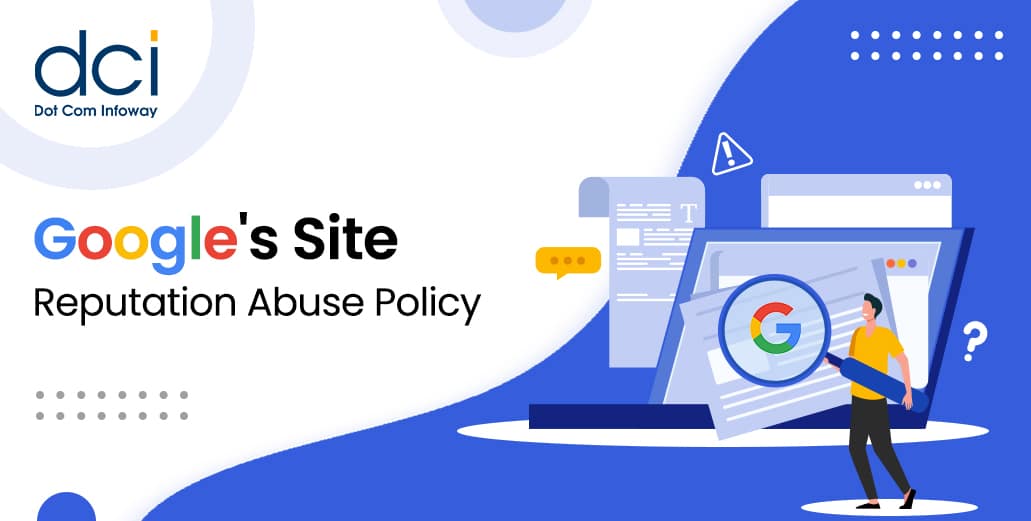
Over the years, less powerful websites in terms of search engine rankings have benefited from the authority of a host website by publishing content on this site.
However, sites often take advantage of this connection by publishing content that’s unrelated to the host website, and even by publishing very low-quality content without the involvement of the host publisher. This is a tactic that Google classifies as site reputation abuse.
Mentioned practices by Google – What to do and what not do
Google Search Liaison, however, says that they aren’t discouraging third-party content but only that which they deem to cross the line. Here’s what the company had to say about this: “This is not to say that all third-party content will be penalized. We just aim to take action against those third-party content which were primarily created to manipulate search rankings and with little supervision from the host publisher”
Google further proceeds to provide examples of what it terms site reputation abuse, and here’s what it includes:
An educational website hosting a payday loan page, which is vastly distributed online with the goal of manipulating search rankings.
A medical website hosting a third-party page about “best casinos”
A sports site featuring a third-party page about “workout supplements reviews,” which it had no involvement in writing and so on.
So basically it’s any situation where a website has irrelevant and unhelpful content from a third party that is geared exclusively for the SEO benefit of the third party. Therefore, if you’re publishing third-party content on your website you need to ensure that it relates to your niche, it’s high-quality, and is made to help users rather than purely for the ranking benefits of a third party.
Similarities and differences with parasite SEO
Is site reputation abuse the same as parasite SEO? Not quite parasite SEO involves latching onto a higher authority website, which may allow you to post content to their website and link back to the source, with the host being minimally involved.
Meanwhile, site reputation abuse involves a third party publishing content on a host website simply to gain the ranking power of that host, with the host being completely uninvolved.
While they aren’t interchangeable terms, there are a few similarities as follows:
Both involve a third party publishing on a higher authority website.
They share the ultimate goal of increasing the third-party’s traffic.
The host website may be minimally or completely uninvolved in the content creation.
That said, here’s what sets the two practices apart:
Although extremely controversial, Parasite SEO is technically not an illegality in the SEO world. Site reputation abuse, however, is now certainly a black hat technique.
Site reputation abuse is made purely to manipulate search engine rankings while parasite SEO is not just made for ranking purposes but to provide value to users.
Site reputation abuse usually involves very low-quality content while parasite SEO can have great-quality content
Push your website to Google’s top results through SEO
Elevate your website to the top of Google SERP with our expert SEO strategies. Drive Traffic, Increase Visibility, and Dominate search results.
The Repercussions for violating the site’s Reputation Abuse Policy
It’s clear that Google will not take kindly to site reputation abuse, but what exactly will they do to websites that they deem guilty of the offense? Well, it’s best to hear from the horse’s mouth:
“Content that constitutes site reputation abuse will be blocked from Google search to avoid violating our spam policies” – Google Search Control
In other words, a page that has content of this nature may be completely cut off from search traffic. Whether this will affect traffic for the website overall or just the affected page only, however, is still up in the air.
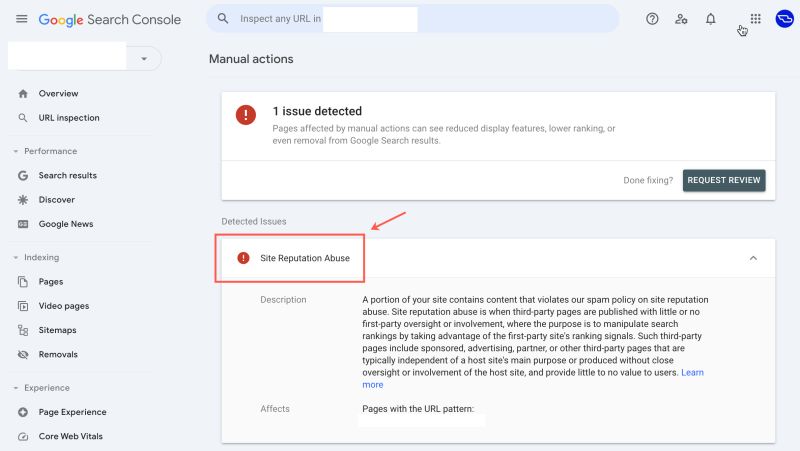
Better yet, you can make this process easier by using the Google Search Console tool. This will give you notifications if there is a problem with any of your Google-indexed pages via the Manual Action section so that you can rectify any problems.
How you can SEO trouble after May 5TH
The site reputation abuse policy is now active, but there’s a lot you can do to ensure your site isn’t affected by this update.
Most importantly, you need to review all the third-party content on your website to ensure that:
The content is relevant to your niche and your site’s content
It provides excellent value to users
You were involved in the content creation process and it is up to quality standards
It is extremely high-quality
If it doesn’t meet this criteria and doesn’t benefit your website in any way, then you may be better off removing this content from your website so that you don’t risk attracting Google penalties.
For years, the mobile experience has followed a familiar pattern: users open an app, navigate through menus, enter information, select an action, and wait for a result.
Agentic AI is beginning to change that model.
Instead of requiring users to manually...
You publish high-quality content, optimize your website, and follow SEO best practices, but your pages still struggle to appear on search engines. You are not alone. Many businesses face the same challenge where their content exists online but fails...
A website can appear successful on the surface while quietly developing problems underneath. It may load correctly, handle current visitors, and support existing business operations, but that does not always mean it has a scalable website architecture prepared for...
Video has become one of the most important communication tools for modern B2B businesses. Companies use videos to explain complex products, showcase solutions, educate customers, support sales teams, and build stronger brand connections. However, as businesses demand more content...
The mobile app development landscape is changing faster than ever. Businesses today need powerful digital products delivered quickly, but traditional development processes often involve long coding cycles, separate teams for different platforms, and higher development costs.
The rise of AI-powered...
The mobile industry is moving from traditional application experiences toward intelligent, adaptive platforms. Businesses today need AI-ready mobile apps that can support emerging technologies like Apple Intelligence and Android Gemini Advanced to deliver faster, smarter, and more personalized user...
An application can receive excellent ratings, positive customer feedback, and strong user satisfaction but still struggle to attract new users. Low app downloads despite good reviews is a challenge many businesses face after launching their mobile applications. While reviews...
The Apple A20 Pro chip changes what product teams can reasonably ask an iPhone app to do in real time. Built on a 2-nanometer process, the processor combines a six-core CPU, seven-core GPU, integrated Neural Accelerators, a dual 16-core...
SEO has changed significantly over the years. Search engines no longer evaluate content only based on keywords, backlinks, or publishing frequency. Today, factors such as content quality, expertise, originality, and user satisfaction play a major role in determining search...
When organic sessions decline after a broad Google update, an E-E-A-T audit checklist gives businesses a structured way to separate correlation from cause. Traffic is rarely restored by inserting more keywords, increasing word count, or changing publication dates. Sustainable...








![The Game Marketing Guide: Pre and Post-Launch Strategies [Infographic]](https://www.dotcominfoway.com/wp-content/uploads/2023/09/DCI-Game-Marketing-blog-1.jpg)